
Circuit breakers are among the most important safety devices in your home’s electrical system. They protect electrical wiring from excessive current, help prevent electrical fires, and allow you to safely disconnect power when repairs or maintenance are needed. Most homeowners rarely think about their breakers until the lights go out, an appliance stops working, or a switch in the electrical panel refuses to stay on.
A tripped circuit breaker is not necessarily a sign that something is broken. In many cases, it means the device is doing exactly what it was designed to do. However, repeated trips, unusual noises, or visible damage can indicate an electrical problem that needs professional attention.
Understanding how circuit breakers work, what causes them to trip, and when they need replacement can help you recognize potential hazards before they become serious.
For homeowners in Forest Lake, Minneapolis, St. Paul, and the surrounding Twin Cities, knowing the condition of your electrical panel is particularly important when updating an older home, installing new appliances, or adding electrical equipment such as an EV charging station.
What Are Circuit Breakers?
A circuit breaker is an electrical safety device that automatically interrupts the flow of electricity when it detects certain unsafe conditions, such as an overload or short circuit.
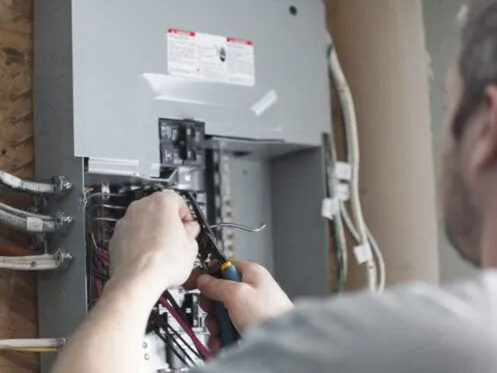
Circuit breakers are typically installed inside an electrical panel, sometimes called a breaker box or distribution panel. Each breaker protects a specific circuit or group of circuits supplying electricity to outlets, lighting, appliances, and other equipment.
For example, your home may have separate breakers for the kitchen outlets, bedroom lighting, air conditioning system, electric dryer, and garage.
When electricity flows normally, the breaker remains closed, allowing power to reach the connected equipment. If current exceeds the breaker’s operating limits, its internal mechanism opens the circuit and stops the flow of electricity.
Unlike a traditional fuse, which must be replaced after it operates, a circuit breaker can generally be reset after the underlying problem has been corrected.
The purpose of a breaker is not simply to prevent an inconvenience. Its primary job is to protect the electrical conductors and equipment connected to the circuit from dangerous overcurrent conditions.
Why Circuit Breakers Are Essential for Electrical Safety
Every electrical circuit has a limit on how much current it can safely carry. That limit depends on several factors, including wire size, conductor material, insulation rating, installation conditions, and the equipment being supplied.
When current exceeds safe levels, electrical conductors can overheat. Excessive heat may damage insulation, weaken connections, and increase the risk of an electrical fire.
Circuit breakers help reduce these risks by disconnecting power when an overload or fault occurs.
They also provide a convenient way to isolate individual circuits. An electrician can turn off a specific breaker while working on an outlet, light fixture, or electrical component, although proper testing is still required to verify that the equipment is de-energized.
A properly selected and installed breaker is one part of a safe electrical system. The wiring, connections, outlets, grounding, and electrical panel must also be in good condition.
How Do Circuit Breakers Work?
Circuit breakers monitor electrical current and interrupt the circuit when conditions exceed their designed operating limits.
Most standard residential breakers use a thermal-magnetic mechanism. This design provides protection against two different problems: sustained overloads and high-current short circuits.
Thermal Protection Against Overloads
The thermal portion of a circuit breaker responds to excessive current that continues over time.
Inside the breaker is a metal component called a bimetallic strip. When current flows through the breaker, the strip heats up. Under normal conditions, this heating remains within the device’s operating range.
If too much current flows for too long, the strip bends enough to activate the trip mechanism.
Consider a 15-amp circuit supplying several outlets in a bedroom. A homeowner plugs in a portable heater while other devices are operating on the same circuit. If the combined electrical demand becomes excessive, the breaker may trip.
Thermal protection is intentionally time-dependent. A modest overload may take longer to trip the breaker than a severe overload.
This helps accommodate certain temporary increases in current, such as the brief starting surge of a motor, without unnecessarily shutting down the circuit.
Magnetic Protection Against Short Circuits
The magnetic portion responds much more quickly to substantial fault currents.
A short circuit occurs when electricity takes an unintended low-impedance path, potentially allowing a very large amount of current to flow.
For example, damaged insulation may allow a hot conductor to contact a neutral conductor or another conductive surface.
When a sufficiently high fault current flows through the breaker, its electromagnetic mechanism trips almost immediately.
This rapid response helps limit damage to electrical wiring and equipment.
However, not every electrical fault produces enough current to trip a conventional breaker quickly. That is one reason additional protective devices, including arc-fault and ground-fault protection, are important.
What Happens Inside a Breaker When It Trips?
When a breaker detects a condition that activates its protective mechanism, several things happen:
- The trip mechanism releases the internal contacts.
- The contacts separate and interrupt the electrical current.
- An internal arc-control system helps extinguish the electrical arc formed as the contacts open.
- The breaker handle moves to its tripped position, which may be between ON and OFF.
- The affected circuit loses power.
After the fault has been addressed, a resettable breaker can usually be returned to service.
The key point is that the breaker responds to an electrical condition. Resetting it does not eliminate whatever caused the trip.
Different Types of Circuit Breakers Used in Homes
Not all circuit breakers provide the same protection. Modern residential electrical systems use several types, each designed for particular applications.
Understanding these differences helps explain why replacing an older breaker with a newer model is not always a simple one-for-one decision.
Standard Single-Pole Circuit Breakers
Single-pole breakers are common in residential electrical panels.
They typically protect 120-volt branch circuits used for general-purpose outlets, lighting, and smaller appliances.
Common ratings include 15 amps and 20 amps.
A 15-amp breaker may protect a circuit serving bedroom lighting or receptacles, while a 20-amp breaker is often used for kitchen, bathroom, laundry, or other circuits with greater electrical demands.
The breaker rating must be coordinated with the circuit conductors and applicable electrical code requirements.
For example, 14 AWG copper conductors are generally protected by a maximum 15-amp breaker in typical residential branch-circuit applications. Standard 12 AWG copper branch-circuit wiring is commonly protected by a 20-amp breaker.
Installing a higher-rated breaker without verifying the wiring is unsafe because the conductors may overheat before the breaker trips.
Double-Pole Circuit Breakers
Double-pole breakers are commonly used for 240-volt equipment.
They connect to both ungrounded legs of a typical residential split-phase electrical system and provide a common disconnecting mechanism.
Equipment that may require double-pole breakers includes:
- Electric ranges and ovens
- Electric clothes dryers
- Central air conditioning equipment
- Electric water heaters
- Certain electric heating systems
- Level 2 EV charging stations
Common residential double-pole breaker ratings include 20, 30, 40, 50, and 60 amps, although other ratings are available.
The correct breaker size depends on the equipment specifications, conductor sizing, and applicable electrical requirements.
A larger breaker is not automatically better. It must be appropriate for the circuit it protects.
GFCI Circuit Breakers
A ground-fault circuit interrupter, or GFCI, breaker provides protection against certain electrical shock hazards.
Unlike a standard breaker, which primarily responds to overcurrent, a GFCI breaker monitors the difference between current leaving and returning through the circuit.
If the difference exceeds its trip threshold, the device quickly disconnects power.
GFCI protection is particularly important in locations where electricity and moisture may come into contact.
Depending on the applicable electrical code and installation, GFCI protection may be required for circuits or receptacles in bathrooms, kitchens, garages, unfinished basements, laundry areas, and outdoor locations.
A GFCI breaker can protect multiple outlets on a branch circuit, making it a useful alternative to installing individual GFCI receptacles in certain situations.
AFCI Circuit Breakers
An arc-fault circuit interrupter, or AFCI, breaker is designed to detect certain dangerous electrical arcing conditions.
Electrical arcing can occur when current jumps across an unintended gap or damaged connection. Some arcs generate enough heat to ignite nearby combustible materials without producing the high current needed to trip a conventional breaker.
Potential causes include damaged cords, deteriorated wiring, and certain loose or compromised electrical connections.
AFCI breakers use electronic detection technology to identify characteristics associated with hazardous arcing and disconnect the circuit.
AFCI protection is required for many residential living-area circuits under modern electrical codes, subject to the locally adopted code and applicable exceptions.
Dual-Function AFCI/GFCI Breakers
Dual-function breakers combine arc-fault and ground-fault protection in a single device.
They can be useful when a circuit requires both types of protection.
For example, certain kitchen or laundry circuits may require protection against electrical arcing as well as ground faults.
Instead of using separate protective devices, an electrician may install a listed dual-function breaker that is compatible with the electrical panel.
Dual-function breakers should not be confused with ordinary AFCI breakers or GFCI breakers. Each device has different protective capabilities.
Main Circuit Breakers
The main breaker serves as the primary disconnect for a home’s electrical panel when the panel is equipped with one.
It is commonly rated at 100, 150, or 200 amps in residential installations, although other service sizes exist.
Turning off the main breaker disconnects power to the branch circuits supplied by that panel. However, portions of the service equipment may remain energized, even when the main breaker is off.
A main breaker also provides overcurrent protection for the equipment and conductors it is designed to protect.
If a home needs more electrical capacity, replacing the main breaker alone is not sufficient. The service conductors, panel rating, utility supply, and calculated electrical load must all be evaluated.
Circuit Breaker Amperage: What Do 15, 20, 30, and 50 Amps Mean?
The amperage printed on a circuit breaker identifies its rated current.
This rating helps determine how much electrical current the protected circuit can carry under specified conditions.
However, the breaker rating does not mean that every connected device can continuously draw that amount of current without additional considerations.
For certain continuous loads, branch-circuit conductors and overcurrent devices must be sized at 125% of the continuous load, unless applicable equipment and code provisions allow otherwise.
A continuous load is generally one where the maximum current is expected to continue for three hours or more.
| Breaker rating | Common residential applications |
| 15 amps | General lighting and receptacle circuits |
| 20 amps | Kitchen, bathroom, laundry, and general-purpose circuits |
| 30 amps | Many electric dryers and certain water heaters |
| 40 amps | Some electric ranges, HVAC equipment, and EV chargers |
| 50 amps | Certain ranges and Level 2 EV charging circuits |
| 60 amps | Selected heating equipment, EV charging installations, and subpanel feeders |
| 100–200 amps | Common residential main breaker ratings |
These are examples rather than universal requirements. Actual breaker sizing must follow equipment instructions, electrical calculations, and code requirements.
How Much Power Can a Circuit Breaker Handle?
Electrical power is calculated by multiplying voltage by current.
Watts = Volts × Amps
For example, a 120-volt circuit with a 20-amp breaker has a nominal capacity of:
120 volts × 20 amps = 2,400 watts.
For a continuous load subject to the usual 80% loading limitation, the allowable load would generally be:
2,400 watts × 0.80 = 1,920 watts.
This distinction matters when using equipment such as portable heaters or installing an EV charger that operates for several hours.
It is also important to understand that a 20-amp circuit does not necessarily have enough available capacity for a new appliance simply because it has a 20-amp breaker. Existing loads and the circuit’s intended use must be considered.
Why Do Circuit Breakers Trip?
A tripping circuit breaker is one of the most common electrical complaints homeowners experience.
Sometimes the explanation is straightforward. Other times, repeated tripping indicates a wiring defect, malfunctioning appliance, or deteriorating electrical component.
The most important step is identifying the cause rather than repeatedly restoring power.
Overloaded Electrical Circuits
An overload occurs when the equipment connected to a circuit draws more current than the circuit can safely handle.
This frequently happens when several high-wattage devices operate simultaneously.
For example, a homeowner might use a microwave, toaster oven, and electric kettle on the same kitchen circuit.
Each appliance may work normally when operated individually. Running them together, however, may exceed the circuit’s capacity.
The breaker then trips to protect the wiring.
Occasional overloads can sometimes be avoided by redistributing equipment across appropriate circuits. Persistent overloads may indicate that additional dedicated circuits are needed.
Short Circuits
Short circuits can produce substantial current and cause breakers to trip very quickly.
Possible causes include damaged insulation, improperly connected wiring, defective appliances, and conductors contacting surfaces they should not touch.
A breaker that trips immediately after being reset may indicate a short circuit, although other faults can produce similar behavior.
Short circuits should be investigated promptly because of the potential for electrical arcing, overheating, and equipment damage.
Ground Faults
A ground fault occurs when electrical current flows along an unintended path to ground or grounded conductive material.
Ground faults can result from damaged wiring, moisture intrusion, faulty appliances, or compromised electrical connections.
Some ground faults create enough current to trip a conventional breaker. Others may involve relatively small leakage currents that require GFCI protection to detect.
Bathrooms, kitchens, garages, and outdoor electrical installations deserve particular attention because moisture and grounded surfaces can increase shock risks.
Faulty Appliances
A defective appliance can cause repeated breaker trips even when the home’s wiring is otherwise functioning correctly.
Refrigerators, dishwashers, washing machines, air conditioners, and other equipment may develop internal electrical faults.
A breaker that trips only when one particular appliance operates may point toward a problem with that equipment.
However, this pattern does not establish the cause by itself. An overloaded circuit, incorrect breaker selection, or wiring issue may produce similar symptoms.
Loose or Damaged Electrical Connections
Loose electrical connections can create resistance, localized heating, intermittent power, and electrical arcing.
A standard circuit breaker may not trip solely because a connection is loose.
That makes warning signs such as flickering lights, discoloration, buzzing, or a burning odor especially important.
Connections can deteriorate over time because of improper installation, thermal cycling, corrosion, or physical damage.
A qualified electrician can inspect and test the circuit to determine whether connections need repair or replacement.
Worn or Defective Circuit Breakers
Circuit breakers can fail.
Repeated fault interruptions, excessive heat, mechanical damage, contamination, and aging can affect their performance.
A breaker may trip unexpectedly, refuse to reset, develop a damaged operating mechanism, or show evidence of overheating.
Still, a breaker that trips frequently should not automatically be considered defective. In many cases, it is responding correctly to a problem elsewhere in the electrical system.
Professional troubleshooting helps distinguish a faulty breaker from an unsafe circuit.
What to Do When a Circuit Breaker Trips
When power suddenly goes out in part of your home, checking the electrical panel can help determine whether a breaker has tripped.
Before attempting a reset, pay attention to the circumstances.
Was a space heater running? Did the power go out when an appliance started? Is there a burning smell, unusual noise, or evidence of water near the panel?
These details can help identify the source of the problem.
How to Reset a Tripped Circuit Breaker
If there are no signs of electrical damage or other unsafe conditions, a homeowner can generally reset a standard breaker using the following steps:
- Turn off or unplug equipment connected to the affected circuit.
- Locate the electrical panel and identify the tripped breaker.
- Move the breaker handle fully to the OFF position.
- Move it firmly back to the ON position.
- Check whether power has returned.
Some breakers move to a center position when they trip, while others use a separate trip indicator.
If the breaker trips again, leave it off and arrange for electrical troubleshooting.
Do not repeatedly reset a breaker that continues to trip. Repeatedly energizing a faulty circuit can expose damaged components to additional electrical stress.
If the panel is hot, wet, damaged, buzzing, or producing a burning odor, do not touch it. Contact a qualified electrician.
What If a Circuit Breaker Will Not Reset?
A breaker that refuses to stay on may be responding to an active electrical fault.
Possible explanations include a short circuit, ground fault, overload, defective connected equipment, or an internal breaker problem.
Some electronic breakers also require specific reset procedures.
If the breaker immediately trips again or the handle will not operate normally, professional inspection is the appropriate next step.
For more detailed troubleshooting, see our guide on why a circuit breaker keeps tripping.
Signs Your Circuit Breakers Need Repair or Replacement
Circuit breakers are designed for long-term service, but they are not immune to wear or damage.
A breaker does not need replacement simply because it is old. Its condition, compatibility, operating history, and performance are more important than age alone.
Several warning signs should prompt an electrical inspection.
Frequent Breaker Trips
A breaker that trips repeatedly during ordinary use may indicate excessive circuit demand, a fault in the wiring, or a problem with connected equipment.
Replacing the breaker without diagnosing the cause can leave the original hazard unresolved.
Burning Smells or Discoloration
A burning odor near the electrical panel is a serious warning sign.
Discolored breaker handles, melted plastic, scorch marks, and unusual heat may indicate overheating or damaged electrical connections.
These conditions require prompt professional attention.
Buzzing or Crackling Sounds
Electrical panels should not produce persistent buzzing, crackling, or popping sounds.
Such noises may indicate electrical arcing, loose connections, damaged equipment, or other abnormal conditions.
Do not remove the panel cover or attempt to investigate energized components.
Breakers That Feel Loose or Damaged
A breaker that appears physically damaged, does not operate correctly, or seems improperly seated may require replacement or additional panel repairs.
Problems can also develop where the breaker connects to the panel’s bus bar.
Replacing the breaker alone may not correct damage to the underlying panel components.
Breakers That No Longer Provide Reliable Protection
Certain breaker problems are not visible.
An internal mechanism may become damaged or fail to operate as intended.
Electricians evaluate breaker condition using appropriate inspection and testing methods, along with manufacturer guidance.
A breaker that has suffered severe electrical damage should not be returned to service simply because its handle still moves.
How Long Do Circuit Breakers Last?
Many residential circuit breakers remain in service for several decades.
A commonly cited planning range is approximately 30 to 40 years, but this is not a guaranteed lifespan or a universal replacement interval.
Actual service life depends on operating conditions, product quality, electrical loading, environmental exposure, and fault history.
A breaker installed in a dry, properly maintained electrical panel may perform differently from one exposed to moisture, corrosion, excessive heat, or repeated electrical faults.
The age of the electrical panel also matters.
Older panels may have obsolete breaker designs, damaged bus connections, or limited availability of compatible replacement parts.
An electrician can assess whether individual breaker replacement is appropriate or whether the panel itself needs attention.
Circuit Breaker Replacement vs. Electrical Panel Replacement
Homeowners sometimes assume that a breaker problem means the entire electrical panel needs to be replaced.
That is not always the case.
If the panel is in good condition and the problem is isolated to one defective breaker, replacing that breaker may be sufficient.
However, certain conditions make a larger electrical upgrade worth considering.
When Replacing One Breaker Makes Sense
Individual circuit breaker replacement may be appropriate when:
- The existing breaker is defective or damaged.
- The electrical panel remains in safe operating condition.
- A properly listed and compatible replacement is available.
- The circuit wiring and connected equipment are suitable for the replacement.
- The panel bus and breaker connections show no significant damage.
The replacement must be approved for use in the specific panel.
Breakers that look alike are not necessarily interchangeable. Different manufacturers use different designs, mounting systems, and listing requirements.
Installing an incompatible breaker can create poor electrical connections and overheating hazards.
When an Electrical Panel Upgrade May Be Necessary
A panel upgrade may be appropriate when the existing equipment is deteriorated, obsolete, damaged, or unable to accommodate required circuits.
Common reasons include insufficient circuit spaces, damaged bus bars, recurring panel-related problems, and the need for additional electrical capacity.
Older homes may also have fuse boxes or panel equipment that warrants further evaluation because of known reliability concerns.
If the electrical service itself is undersized for the home’s calculated demand, a service upgrade may be necessary.
However, a panel with no spare breaker spaces does not automatically require a larger electrical service. The available capacity and physical panel configuration are separate considerations.
Plugz Electric provides electrical panel repair and replacement services for homeowners in Forest Lake and the surrounding Twin Cities area.
How Much Does Circuit Breaker Replacement Cost?
Circuit breaker replacement costs vary depending on the type of breaker, panel condition, labor requirements, and complexity of the installation.
Replacing a standard single-pole breaker is generally less expensive than replacing a specialized AFCI, GFCI, or high-amperage breaker.
As broad planning estimates, homeowners may encounter the following installed costs for straightforward residential work:
| Service | Approximate cost |
| Standard circuit breaker replacement | 150–300 |
| Double-pole breaker replacement | 175–350 |
| AFCI breaker replacement | 175–400 |
| GFCI breaker replacement | 175–400 |
| Dual-function breaker replacement | 200–450 |
| Electrical troubleshooting and diagnosis | 100–300+ |
These are general estimates, not quoted Plugz Electric prices. Actual Twin Cities pricing depends on the breaker, panel, service conditions, and work required.
Specialized breakers often cost more because they contain additional electronic protection components.
Replacement may also involve diagnosing wiring faults, correcting damaged connections, or repairing panel components.
For that reason, the cost of solving a breaker problem can be greater than the price of the breaker itself.
If you need an accurate estimate to replace your circuit breaker, please give us a call at (612) 295-1595 or you can click on the booking button above to get started.
Factors That Affect Circuit Breaker Replacement Costs
Several factors influence the final cost.
- Breaker type and compatibility: Standard thermal-magnetic breakers typically cost less than specialized protective devices. Older or uncommon panels may require more expensive approved replacements.
- Electrical panel condition: Damaged connections, corrosion, or deteriorated bus bars can increase the scope of repairs.
- Diagnostic work: A tripping breaker may require circuit testing before the correct repair can be identified.
- Accessibility: Panels located in difficult-to-access areas may require additional labor.
- Permits and inspections: Depending on the work and local requirements, electrical permits or inspections may be necessary.
A proper diagnosis can prevent unnecessary replacement and help ensure that the repair addresses the actual electrical problem.
Can You Replace a Circuit Breaker Yourself?
Although circuit breakers may appear easy to remove and install, replacing one involves electrical hazards that are not obvious from looking at the panel.
Even when the main breaker is switched off, incoming service conductors and certain internal components may remain energized.
An incorrect installation can also create hazards that do not become apparent until the circuit is heavily loaded.
Professional breaker replacement involves more than matching the amperage printed on the handle.
An electrician must verify the breaker’s listing and compatibility, circuit conductor sizing, connection requirements, panel condition, and protective function.
Minnesota electrical work is also subject to applicable licensing, permitting, and inspection requirements.
For these reasons, circuit breaker replacement is best handled by a qualified electrician.
Circuit Breakers and Older Homes in Minnesota
Many homes throughout Minneapolis, St. Paul, Forest Lake, White Bear Lake, Stillwater, and nearby communities were constructed before today’s electrical demands became common.
Older electrical systems may have been designed around relatively modest loads, with fewer receptacles and circuits than modern homes typically require.
Today, the same property may have central air conditioning, multiple computers, electric cooking equipment, garage appliances, outdoor lighting, and an EV charging station.
The challenge is not simply that homeowners use more electricity. Electrical demand may be concentrated on circuits that were never intended to supply several high-wattage devices simultaneously.
Older Electrical Panels and Outdated Breakers
Some older electrical panels remain suitable for continued use when properly maintained.
Others require closer evaluation because of obsolete components, known equipment concerns, deteriorated connections, or limited breaker availability.
Certain Federal Pacific Electric Stab-Lok panels, for example, have documented concerns involving breaker performance.
A qualified electrician can identify the installed equipment and recommend an appropriate course of action.
The goal is to evaluate the actual electrical system rather than assume that every older panel is unsafe.
Circuit Breakers and Outdated Wiring
Older wiring can introduce additional concerns.
Homes may contain aging insulation, ungrounded circuits, modified wiring, or older aluminum branch-circuit conductors.
A modern breaker cannot correct every underlying wiring problem.
For example, installing a new breaker does not repair deteriorated insulation or improperly terminated conductors.
Where wiring conditions are unsafe or inadequate, professional electrical wiring and rewiring may be necessary.
Why Home Renovations Often Require New Circuits
Kitchen remodels, basement finishing projects, home offices, and garage conversions can significantly change a home’s electrical requirements.
New appliances, additional receptacles, and updated lighting may require dedicated circuits or changes to existing branch circuits.
A renovation is an opportunity to evaluate breaker protection, wiring condition, and panel capacity before walls and ceilings are closed.
Planning the electrical work early can reduce unexpected changes and make future upgrades easier.
Circuit Breakers for EV Chargers and High-Power Appliances
Electric vehicle charging is one of the most common reasons homeowners begin evaluating their electrical panel capacity.
Level 2 EV charging equipment typically operates on a 240-volt circuit and can draw substantial current for extended periods.
Because EV charging is treated as a continuous load, breaker and conductor sizing must account for that demand.
For example, a charger configured to draw 40 amps will commonly require a 50-amp branch circuit under the standard 125% sizing rule.
A charger drawing 48 amps will commonly require a 60-amp circuit.
The equipment’s instructions, circuit configuration, and applicable electrical code determine the final installation requirements.
Does Installing an EV Charger Require a New Electrical Panel?
Not necessarily.
Some homes have enough available electrical capacity and panel space to accommodate a new EV charging circuit.
Others may require load management equipment, changes to existing circuits, a subpanel, or a service upgrade.
An electrical load calculation helps determine the available capacity.
In some cases, an approved energy management system can allow EV charging without increasing the home’s service size.
Plugz Electric provides EV charging installation services throughout its Twin Cities service area, helping homeowners integrate charging equipment into their existing electrical systems.
Circuit Breakers and Whole-Home Surge Protection
Circuit breakers and surge protectors perform different jobs.
A circuit breaker protects against excessive current and certain electrical faults. A surge protective device helps limit transient overvoltages that can damage connected electronics and appliances.
A voltage surge may originate from lightning-related events, utility switching, or electrical equipment operating within the property.
A conventional breaker is not designed to provide comprehensive surge protection.
Whole-home surge protection is typically installed at or near the electrical service equipment, depending on the system design.
Modern electrical codes require surge protection for many new or replaced dwelling-unit electrical services.
Combining properly selected circuit breakers with whole-home surge protection services provides protection against different types of electrical hazards.
Neither device replaces the other.
How to Maintain Circuit Breakers and Electrical Panels
Circuit breakers generally require little routine attention from homeowners, but the electrical panel should not be ignored.
Keeping the panel accessible, dry, and free from physical damage helps support safe operation.
Keep the Electrical Panel Accessible
Electrical panels need adequate working clearance for safe operation and servicing.
Avoid storing boxes, furniture, cleaning supplies, or other belongings directly in front of the panel.
Clear access is especially important during a power outage or electrical emergency.
Label Circuit Breakers Clearly
A well-labeled panel makes it easier to identify which breaker controls a particular area or appliance.
Labels such as “Kitchen Counter Outlets,” “Living Room Lighting,” and “Garage Receptacles” are more useful than vague descriptions.
Circuit directories should be updated whenever electrical work changes the circuits.
Watch for Moisture and Corrosion
Water and electrical equipment are a dangerous combination.
Basement moisture, plumbing leaks, condensation, and water intrusion can damage electrical panels and breaker connections.
Visible corrosion, rust, or signs of water inside the panel should be evaluated professionally.
Test GFCI and AFCI Protection as Directed
Many GFCI and AFCI breakers include a TEST button.
Testing schedules and procedures vary by manufacturer, so follow the instructions provided for the installed device.
If a breaker fails its prescribed test or cannot be restored to normal operation, contact an electrician.
Schedule Electrical Inspections When Problems Develop
A routine electrical inspection may be appropriate when purchasing an older home, planning major electrical upgrades, or noticing warning signs.
An electrician can evaluate the panel, breaker compatibility, circuit loading, grounding and bonding, and visible wiring conditions.
For homeowners experiencing flickering lights, malfunctioning outlets, or repeated trips, professional electrical troubleshooting and repairs can help identify the underlying cause.
Choosing the Right Circuit Breaker for Your Home
Selecting a circuit breaker requires more than choosing the correct amperage.
The device must be suitable for the electrical panel, the protected wiring, the equipment being supplied, and the required type of protection.
Several characteristics matter.
Amperage Rating
The breaker must provide appropriate overcurrent protection for the circuit.
Increasing the amperage to stop nuisance trips is not an acceptable solution unless the entire circuit is evaluated and found suitable for the change.
Panel Compatibility
Breakers must be listed or otherwise specifically approved for use in the panel where they are installed.
Physical fit alone does not establish compatibility.
Voltage Rating
The breaker must be rated for the system voltage and intended application.
Residential circuits commonly operate at 120 or 240 volts, but equipment requirements vary.
Interrupting Capacity
A breaker’s interrupting rating identifies the maximum fault current it can safely interrupt under specified conditions.
The rating must be adequate for the available short-circuit current at the installation.
Required Protective Features
Certain circuits require AFCI protection, GFCI protection, or both.
The applicable requirements depend on the circuit, location, type of work, and locally adopted electrical code.
Choosing the correct device helps ensure that the electrical system meets both safety and functional requirements.
Circuit Breaker Repair and Replacement in Forest Lake and the Twin Cities
Electrical problems are not always isolated to one component.
A circuit breaker that trips repeatedly may be protecting against a wiring fault, overloaded circuit, defective appliance, or deteriorated connection. In other situations, the breaker or electrical panel itself may need repair.
Plugz Electric provides residential and commercial electrical services in Forest Lake and communities throughout the Twin Cities Metro area.
Our electricians work with electrical panels, circuit additions, wiring, outlets, switches, and other components that affect how electricity is distributed throughout your property.
Whether you need help diagnosing a breaker that will not reset or are planning an electrical upgrade, we can evaluate the system and recommend repairs that address the underlying issue.
Our services include electrical troubleshooting, breaker and panel work, wiring and rewiring, outlet installation, surge protection, indoor lighting and outdoor lighting, and EV charging installations.
A breaker problem may be relatively minor, but persistent electrical faults should never be overlooked.
Contact Plugz Electric at 612-295-1595 to schedule electrical service in Forest Lake, Minneapolis, St. Paul, or the surrounding Twin Cities area.
Frequently Asked Questions About Circuit Breakers
What Is the Main Purpose of a Circuit Breaker?
The main purpose of a circuit breaker is to protect electrical conductors and equipment from excessive current. It automatically interrupts electricity when an overload or short circuit causes current to exceed its operating limits. Specialized breakers can also provide protection against certain ground faults and arc faults.
What Causes a Circuit Breaker to Keep Tripping?
Common causes include overloaded circuits, short circuits, ground faults, defective appliances, and damaged wiring. A malfunctioning breaker can also cause unwanted trips. If a breaker trips repeatedly, the circuit should be inspected to identify the underlying problem.
How Do I Know If a Circuit Breaker Is Bad?
Possible signs include a breaker that will not reset, visible damage, unusual heat, a burning odor, or abnormal operation. However, these symptoms may also indicate problems with the circuit or panel. Professional testing is often necessary to determine whether the breaker itself is defective.
Can a Circuit Breaker Go Bad Without Tripping?
Yes. A breaker can develop mechanical or electrical defects that prevent it from operating correctly. In some cases, a defective breaker may fail to interrupt current when required. This is why visible condition alone cannot establish that a breaker is functioning safely.
Is It Dangerous If a Circuit Breaker Keeps Tripping?
Repeated breaker trips can indicate an unsafe electrical condition. Although the breaker may be protecting the circuit as designed, the underlying problem could involve overheating, damaged wiring, or an electrical fault. A breaker that continues to trip should be left off until the cause is identified.
How Many Times Can You Reset a Circuit Breaker?
Circuit breakers are designed to operate multiple times, but there is no universal number of resets that applies to every breaker. Their mechanical and electrical endurance depends on the device and operating conditions. Repeatedly resetting a breaker that trips because of an unresolved fault is unsafe.
How Long Should a Residential Circuit Breaker Last?
Residential circuit breakers can remain in service for several decades, with 30 to 40 years sometimes used as a general planning estimate. Actual lifespan varies based on product design, environmental conditions, loading, and maintenance. A breaker should be evaluated based on its condition and performance rather than age alone.
Can I Replace a 15-Amp Breaker With a 20-Amp Breaker?
Not simply to prevent tripping. A 20-amp breaker may allow more current than the existing wiring can safely carry. Before changing the breaker rating, an electrician must verify conductor sizing, circuit design, connected equipment, and applicable electrical code requirements.
What Is the Difference Between a Circuit Breaker and a Fuse?
Both devices protect electrical circuits against excessive current. A fuse contains an element that melts when current exceeds its operating characteristics and must be replaced afterward. A circuit breaker uses a resettable switching mechanism and can generally be returned to service after the fault has been corrected.
What Is the Difference Between a GFCI and an AFCI Circuit Breaker?
A GFCI breaker detects current imbalance associated with ground faults and provides protection against certain electrical shock hazards. An AFCI breaker detects characteristics of potentially dangerous electrical arcing. Dual-function breakers combine both protective functions in one device.
Why Does My Breaker Trip When I Turn on the Air Conditioner?
An air conditioner may trip a breaker because of excessive current, a compressor or motor problem, damaged wiring, a defective component, or an electrical fault. A breaker that trips during startup may require evaluation of the equipment’s starting current and electrical condition. Repeated trips should be investigated rather than addressed by installing a larger breaker.
Why Does My Circuit Breaker Trip at Night?
A breaker may trip at night because several appliances operate simultaneously, heating equipment cycles on, or a fault occurs in connected equipment. Some problems appear only after a circuit has been under load for an extended period. Tracking which appliances were running can help an electrician diagnose the issue.
Can a Circuit Breaker Cause Flickering Lights?
Yes. A damaged breaker connection or problem within the electrical panel can contribute to flickering lights. However, flickering may also result from loose wiring, voltage fluctuations, overloaded circuits, or utility-related problems. Lights that flicker throughout the home warrant particular attention because the cause may involve a shared electrical connection.
Does a Tripped Breaker Mean My Electrical Panel Is Overloaded?
Not necessarily. A single branch circuit can be overloaded even when the home’s electrical service has adequate capacity. Conversely, a panel may have insufficient available service capacity without individual breakers tripping. An electrical load calculation and circuit evaluation help determine the actual condition.
Do Circuit Breakers Protect Against Power Surges?
Standard circuit breakers are not designed to provide comprehensive protection against voltage surges. They primarily protect against excessive current. Whole-home surge protective devices help limit transient overvoltages that may damage appliances and electronics.
How Much Does It Cost to Replace a Circuit Breaker in Minnesota?
A straightforward residential breaker replacement may cost approximately $150 to $300 for a standard breaker, while specialized AFCI, GFCI, or double-pole breakers may cost more. Actual costs depend on the breaker type, panel condition, troubleshooting requirements, and labor involved.
Do I Need a New Circuit Breaker When Installing an EV Charger?
Many Level 2 EV charging installations require a dedicated branch circuit with a correctly sized breaker. The necessary rating depends on the charger’s configured current, equipment instructions, and applicable electrical requirements. An electrician must also verify that the electrical system can accommodate the additional load.
When Should I Replace My Electrical Panel Instead of Individual Breakers?
Panel replacement may be appropriate when the equipment is damaged, obsolete, incompatible with available breakers, or unsuitable for the property’s electrical needs. If the problem involves only one defective breaker and the panel is otherwise in good condition, individual replacement may be sufficient.
Who Should I Call for Circuit Breaker Repair in Forest Lake, MN?
Plugz Electric provides electrical troubleshooting, repairs, panel services, and electrical upgrades for homeowners and businesses in Forest Lake and throughout the Twin Cities Metro area. If your breaker keeps tripping, will not reset, or shows signs of damage, call 612-295-1595 or visit Plugz Electric’s contact page to schedule an evaluation.