
A ceiling fan that suddenly stops working can leave you wondering whether the problem is a simple setting, a faulty switch, or something more serious with your home’s electrical system. Sometimes, the fan stops spinning while the light continues to work. Other times, the entire fixture loses power, makes a humming noise, or only operates at certain speeds.
The good news is that a ceiling fan not working doesn’t always mean you need a replacement. Many problems come from remote control issues, tripped circuit breakers, worn-out capacitors, faulty switches, or loose electrical connections. Identifying the symptoms can help you determine what went wrong and whether the problem requires professional electrical repair.
Before replacing your ceiling fan, it’s worth understanding how the different components work together. A problem that appears to involve the fan motor may actually originate in the wall switch, wiring, or electrical circuit supplying power to the fixture.
This guide explains the most common reasons ceiling fans stop working, how to troubleshoot common problems safely, and when to contact a licensed electrician for repairs.
Why Is My Ceiling Fan Not Working?
When a ceiling fan stops working, the cause generally falls into one of three categories: a power supply problem, a control malfunction, or a mechanical or electrical failure inside the fan.
A ceiling fan relies on several components to operate correctly. Electricity travels through your home’s wiring to the fan, where switches, electronic controls, and motor components regulate operation. If any part of that process fails, the fan may stop spinning or behave unpredictably.
Some of the most common reasons a ceiling fan won’t work include:
- A tripped circuit breaker or interrupted power supply
- A faulty wall switch or fan speed controller
- Dead remote control batteries or a malfunctioning receiver
- A defective ceiling fan capacitor
- Loose or damaged electrical wiring
- A worn-out or overheated fan motor
- A malfunctioning pull chain switch
- A failed electronic control module
- Mechanical resistance from damaged motor bearings
- An incompatible dimmer switch or speed controller
The symptoms often provide useful clues.
For example, a ceiling fan that hums but won’t spin may have a capacitor or motor problem. A fan that stops working immediately after installing a new wall switch may have an incompatible control. If the ceiling fan and light both stop working, the problem could involve the circuit breaker, wall switch, remote receiver, or electrical connections.
Understanding these differences helps narrow down the possible causes before repairs begin.
How to Troubleshoot a Ceiling Fan That Stopped Working
If your ceiling fan isn’t turning on, start with basic checks that don’t require opening the fixture or handling electrical wiring.
1. Check the Wall Switch
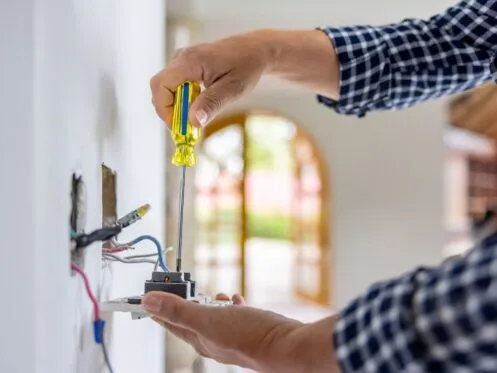
The first thing to inspect is the wall switch controlling the ceiling fan.
Some ceiling fans have separate switches for the fan motor and light fixture. Others use a single switch to supply power to both components.
Make sure the switch is in the correct position. If the fan has a pull chain, confirm that it hasn’t been left in the off position.
If the wall switch feels loose, makes a crackling sound, becomes unusually warm, or only works intermittently, stop using it. These symptoms may indicate damaged contacts or loose electrical connections.
A licensed electrician can inspect the switch and determine whether it needs replacement.
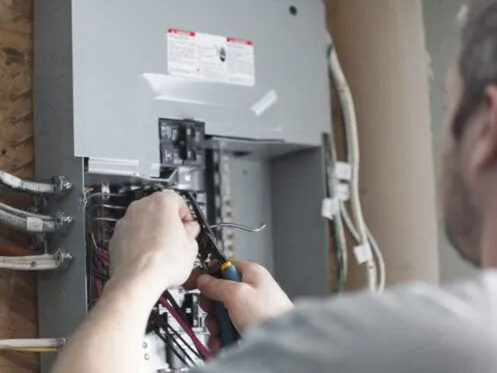
2. Inspect the Circuit Breaker
A tripped circuit breaker can interrupt electricity to your ceiling fan.
Locate your home’s electrical panel and check whether the breaker controlling the room has tripped.
Some breakers move to a middle position when they trip, making the problem less obvious.
If the breaker has tripped, you can generally reset it once by moving it fully to the off position and then back on, provided there are no signs of electrical damage, moisture, smoke, or burning.
If the breaker trips again, leave it off and contact an electrician.
Repeated breaker trips may indicate a short circuit, damaged wiring, or another electrical fault that requires professional troubleshooting.
3. Check the Ceiling Fan Remote Control
If your ceiling fan uses a remote control, the problem may be unrelated to the motor.
Start by replacing the batteries.
Next, verify that the wall switch supplying power to the fan is turned on. Many remote-controlled ceiling fans still require constant power from a wall switch.
Some models also have pairing or synchronization procedures. If the remote loses communication with the receiver, the fan may stop responding even though electricity is reaching the fixture.
Consult the manufacturer’s instructions for the correct pairing procedure.
If the remote still doesn’t work, the receiver inside the ceiling fan canopy may be defective.
4. Inspect the Pull Chain
Traditional ceiling fans often use pull chains to control the fan speed and lighting.
Over time, the internal switch mechanism can wear out.
Common signs of a faulty pull chain switch include:
- The chain pulls without changing the fan speed.
- The chain becomes stuck.
- The fan only operates at one speed.
- The chain breaks or disconnects from the switch.
- The fan no longer responds when the chain is pulled.
A broken pull chain does not necessarily mean the entire ceiling fan needs replacement.
In many cases, an electrician can replace the switch assembly if a compatible component is available.
5. Look for Signs of Mechanical Problems
With the fan switched off and the blades completely stopped, look for visible damage or obstructions.
Check whether anything is touching the blades or interfering with their movement.
A damaged blade, loose component, or foreign object can interfere with normal operation.
Avoid forcing the blades to turn, particularly if the fan recently overheated, made unusual noises, or stopped suddenly.
Mechanical resistance can indicate damaged bearings or internal motor problems.
If the fan makes grinding or scraping noises, professional inspection is the safest approach.
Ceiling Fan Not Working but Light Works
One of the most common ceiling fan problems occurs when the light turns on normally, but the fan blades won’t spin.
This situation is particularly confusing because the fixture clearly has electricity.
However, ceiling fan lights and motors often use separate internal circuits, switches, or control components.
The fact that the light works doesn’t necessarily mean the fan motor is receiving power.
Faulty Fan Capacitor
Many conventional AC ceiling fans use capacitors to help establish the electrical conditions needed for motor operation.
A failing capacitor can prevent the fan from starting or cause it to operate at reduced speed.
Common symptoms include a fan that hums without spinning, starts inconsistently, or runs slower than normal.
Capacitor failures are particularly common in older ceiling fans.
Replacing the capacitor requires identifying the correct electrical specifications and safely accessing the fan’s internal components.
Because capacitors can retain an electrical charge, replacement should be handled by someone qualified to work on electrical equipment.
Damaged Fan Speed Switch
A fan speed switch regulates motor operation by selecting different electrical connections or control settings.
When the switch fails, the fan may stop responding even though the lighting circuit continues working.
The problem may develop gradually. You might notice that the highest speed works while the lower settings become unreliable.
Eventually, the fan may stop spinning altogether.
An electrician can test the switch and determine whether replacing it will restore operation.
Defective Remote Receiver
Remote-controlled ceiling fans often contain an electronic receiver that processes commands from the remote.
The receiver may have separate outputs for the fan motor and light.
If the fan-control portion fails, the light may continue operating while the blades remain stationary.
The receiver may need replacement, depending on the model and availability of compatible components.
Failed Fan Motor
If the capacitor, controls, and electrical connections are functioning correctly, the motor itself may be defective.
A failed motor can prevent the blades from spinning even when the light works normally.
Motor replacement is possible on some ceiling fans, but replacing the entire fixture is often more economical, particularly for older or inexpensive models.
Ceiling Fan and Light Both Not Working
When the fan and light stop working at the same time, the problem is more likely to involve a component shared by both systems.
The first possibility is an interrupted power supply.
A tripped circuit breaker, defective wall switch, or loose electrical connection can prevent power from reaching the fixture.
Another possibility is a failed remote receiver or electronic control module. On certain ceiling fans, both the motor and light depend on the same control unit.
Electrical wiring problems can also produce this symptom.
Connections inside the ceiling fan canopy may deteriorate because of improper installation, vibration, or previous electrical work.
A loose connection can interrupt power or create excessive resistance and heat.
If both components suddenly stop working and basic control checks don’t solve the problem, an electrician can test the circuit to locate the interruption.
Ceiling Fan Humming but Not Spinning
A humming ceiling fan that refuses to spin deserves attention because the motor may be receiving electricity without operating correctly.
Several problems can produce this symptom.
A Bad Capacitor May Prevent the Motor From Starting
In many traditional ceiling fan motors, the capacitor helps produce the phase relationship needed for the motor to develop starting torque.
When the capacitor fails, the motor may hum without generating enough torque to rotate the blades.
The fan might also struggle to start or run at an unusually slow speed.
Continuing to operate a stalled motor can cause overheating and additional damage.
Turn the fan off and arrange an inspection rather than leaving it humming.
Worn Motor Bearings Can Restrict Movement
Motor bearings allow the fan’s rotating components to move smoothly.
As bearings wear, friction increases.
You may notice grinding sounds, irregular movement, or a fan that becomes increasingly difficult to start.
Eventually, the motor may stop turning.
Replacing the motor or entire ceiling fan may be necessary if the bearings are severely damaged.
An Incompatible Wall Control Can Cause Humming
Not every wall-mounted speed controller is compatible with every ceiling fan.
For example, a standard lighting dimmer should not be used to regulate a conventional ceiling fan motor unless the manufacturer specifically approves that application.
Incompatible controls can cause humming, erratic operation, overheating, or premature component failure.
Modern DC-motor ceiling fans may require proprietary electronic controllers rather than traditional AC fan speed switches.
When installing a replacement wall control, the fan’s motor type and manufacturer requirements must be considered.
Ceiling Fan Won’t Turn On After a Power Outage
Power outages and electrical disturbances can sometimes affect ceiling fan operation.
A fan may stop responding after electricity is restored, even though other devices in the room work normally.
Several explanations are possible.
A circuit breaker may have tripped during the interruption or restoration of power.
An electronic receiver may also need to be reset or paired with its remote control again.
In some cases, an electrical surge can damage sensitive components inside the fan.
Ceiling fans with integrated LED lighting, DC motors, or smart controls contain electronic circuitry that may be more vulnerable to certain voltage disturbances than basic mechanical controls.
If the ceiling fan stopped working after a power outage, check the breaker and follow the manufacturer’s recommended reset procedure.
If the problem continues, professional electrical testing can determine whether the fan’s electronics or the supplying circuit has been damaged.
Can Surge Protection Prevent Ceiling Fan Damage?
Surge protection can help reduce the risk of damage caused by certain transient voltage spikes.
A whole-home surge protective device installed at the electrical panel provides an additional layer of protection for connected equipment, including ceiling fans with electronic controls.
However, surge protection cannot prevent every type of electrical failure or power-quality problem.
Homes with multiple smart devices, modern lighting systems, and electronic appliances may benefit from a professionally installed whole-home surge protection system.
Plugz Electric provides surge protection services for homeowners throughout Forest Lake and the Twin Cities metro area.
Ceiling Fan Only Works on One Speed
A ceiling fan that operates on high but not medium or low, or works on only one setting, often has a control-related problem.
The most likely causes depend on the fan’s design.
For traditional AC ceiling fans, a failing capacitor or defective speed switch can interfere with speed selection.
For remote-controlled models, the receiver or electronic controller may be malfunctioning.
Modern DC ceiling fans use electronic motor controls, so a failure in the control board can produce similar symptoms.
An incompatible wall speed controller may also prevent the fan from operating correctly.
If the problem started after installing a new switch, check whether the control is specifically rated for the ceiling fan.
An electrician can identify the motor and control configuration before recommending replacement components.
Ceiling Fan Running Slowly Even on High Speed
A ceiling fan that spins slowly despite being set to its highest speed may be experiencing an electrical or mechanical problem.
Possible causes include a deteriorating capacitor, motor wear, control failure, or abnormal mechanical resistance.
A fan may also appear to run slowly because the wrong speed setting is selected on a remote control or wall controller.
Dust accumulation on the blades can affect balance and efficiency, but substantial speed loss is more likely to involve the motor or its controls.
If the fan previously operated normally and has gradually slowed down, an electrician can evaluate the capacitor, motor, and electrical supply.
A ceiling fan that becomes unusually hot, produces a burning smell, or makes abnormal noises should be turned off until the problem is resolved.
Ceiling Fan Stopped Working Suddenly
When a ceiling fan stops without warning, consider what happened immediately before the failure.
Did the fan make a popping sound? Did the lights flicker? Was there a recent storm or power outage? Did someone replace a wall switch?
These details can help identify the cause.
A sudden failure may result from a tripped breaker, failed electronic control, damaged motor component, or interrupted electrical connection.
If the fan stopped during normal operation and there are no other symptoms, begin with the wall switch, remote control, and breaker.
However, a sudden failure accompanied by a burning smell, smoke, sparks, or unusual heat requires immediate attention.
Turn off the circuit if it is safe to do so and contact a licensed electrician.
Why Does My Ceiling Fan Keep Turning Off?
A ceiling fan that repeatedly shuts itself off may have a different problem from one that won’t start at all.
Intermittent operation can indicate overheating, an unreliable electrical connection, or a malfunctioning electronic controller.
Motor Overheating
Some ceiling fan motors include thermal protection that interrupts operation when internal temperatures become excessive.
The fan may stop after running for a while and resume operating once the motor cools.
This behavior can indicate excessive friction, a motor defect, or another condition causing overheating.
Repeated shutdowns should not be ignored.
Loose Electrical Connections
A loose electrical connection may cause intermittent operation.
As the fan vibrates, a marginal connection can temporarily interrupt power.
Electrical resistance at a poor connection can also generate heat.
An electrician can inspect the wiring and connections inside the fan canopy, wall switch box, and associated circuit.
Faulty Electronic Controls
Smart ceiling fans and remote-controlled models may shut down unexpectedly because of receiver or controller failures.
Some models also include timers, schedules, or automatic operating modes.
Before assuming the fan is defective, review its programmed settings.
If the fan continues shutting off without a programmed reason, its electronic components may need testing.
Ceiling Fan Wobbles, Makes Noise, or Shakes
A ceiling fan doesn’t have to stop spinning to indicate that something is wrong.
Excessive wobbling, clicking, grinding, or rattling can signal installation problems or worn components.
Loose Blade Hardware
Ceiling fan blades are attached to brackets or motor assemblies using screws and mounting hardware.
Over time, vibration may loosen these connections.
Loose hardware can cause rattling or uneven blade movement.
With the power off and the fan completely stopped, visible blade damage or missing hardware can be identified without opening electrical components.
Damaged or loose components should be corrected before the fan is operated again.
Unbalanced Fan Blades
Ceiling fan blades must rotate with reasonably consistent weight distribution and alignment.
If one blade is bent, damaged, or significantly out of balance, the fan may wobble.
Manufacturer-approved balancing kits can sometimes correct minor blade imbalance.
However, severe wobbling may indicate an installation or mounting problem rather than a blade issue.
Improper Ceiling Fan Mounting
Ceiling fans require an electrical box and mounting assembly specifically rated to support a ceiling fan.
A standard light fixture box may not provide adequate support.
This becomes especially important when replacing an existing ceiling light with a fan.
If the fan visibly moves at the ceiling, the mounting assembly should be inspected by a qualified electrician.
Plugz Electric offers ceiling fan installation and electrical services that help homeowners ensure their fixtures are properly mounted and connected.
Can Faulty Wiring Cause a Ceiling Fan to Stop Working?
Yes. Electrical wiring problems can prevent a ceiling fan from operating even when the fan itself is in good condition.
Ceiling fans depend on reliable connections between the electrical panel, branch circuit wiring, wall switches, and fixture.
A failure anywhere along that path can interrupt operation.
Loose Connections Inside the Ceiling Box
The electrical connections supplying a ceiling fan are typically enclosed within the ceiling box or fan canopy.
If a connection becomes loose, the fan may lose power intermittently or stop working completely.
Poor connections can also create localized heating and increase the risk of electrical damage.
Professional electrical testing can identify these problems without unnecessarily replacing the entire fixture.
Damaged or Aging Electrical Wiring
Older homes may have wiring that has deteriorated or been modified during previous renovations.
Damaged insulation, improper splices, and aging connections can contribute to electrical failures.
Not every ceiling fan problem requires rewiring. However, if an electrician identifies deteriorated wiring, repairing or replacing the affected section may be necessary.
Plugz Electric provides electrical wiring and rewiring services for homeowners in Forest Lake and surrounding Twin Cities communities.
Problems With the Electrical Panel
An electrical panel distributes electricity to the circuits throughout your home.
A defective breaker or other panel problem can interrupt power to a ceiling fan.
If several lights or electrical devices stop working together, the issue may extend beyond the fan.
An electrician can evaluate the affected circuit and determine whether the problem involves the breaker, wiring, or another electrical component.
A ceiling fan failure alone does not mean an electrical panel replacement is necessary.
How to Tell if a Ceiling Fan Motor Is Bad
A failed ceiling fan motor can produce symptoms similar to those caused by defective capacitors or switches.
This makes proper diagnosis important.
Signs that may indicate a bad ceiling fan motor include:
- The fan hums but the blades don’t rotate.
- The motor becomes unusually hot.
- Grinding or scraping noises develop during operation.
- The fan repeatedly shuts down after running.
- The blades struggle to reach normal operating speed.
- The fan stops working despite receiving the correct electrical supply.
These symptoms don’t automatically confirm motor failure.
For example, a faulty capacitor can prevent an otherwise functional AC motor from starting.
An electrician can test the electrical supply, controls, and applicable motor components to determine whether the motor has failed.
If the motor is defective, replacement may be more practical than repair.
Should You Repair or Replace a Ceiling Fan?
Whether to repair or replace a ceiling fan depends on its age, condition, replacement-part availability, and the cost of professional service.
A relatively new fan with a defective switch or receiver may be worth repairing.
An older fan with a failed motor, worn bearings, and outdated controls may be better replaced.
| Problem | Typical solution | Repair or replace? |
| Dead remote batteries | Replace batteries | Repair |
| Broken pull chain switch | Replace compatible switch | Usually repair |
| Failed capacitor | Replace correct capacitor | Often repair |
| Defective remote receiver | Replace receiver | Often repair |
| Loose electrical connection | Professional wiring repair | Repair |
| Worn motor bearings | Motor or fan replacement | Often replace |
| Burned-out motor | Replace motor or fan | Often replace |
| Damaged fan blades | Replace compatible blades | Depends on availability |
| Severe corrosion or structural damage | Replace fan | Replace |
The condition of the existing fixture matters as much as the individual failed component.
A high-quality ceiling fan with readily available replacement parts may justify repairs. An inexpensive fan with multiple electrical or mechanical problems may not.
When Replacing the Ceiling Fan Makes More Sense
Replacement is often the better option when the motor has failed, parts are discontinued, or the fan has experienced significant damage.
A new ceiling fan may also offer improvements in energy efficiency, noise levels, lighting, and convenience.
Many modern models include DC motors, integrated LED lighting, multiple speed settings, and remote or smart home controls.
When replacing an older fan, it’s also a good opportunity to inspect the ceiling box, wiring, and wall controls.
Proper installation helps prevent many of the problems that cause ceiling fans to malfunction.
How Much Does It Cost to Fix a Ceiling Fan?
Ceiling fan repair costs vary based on the component that failed, the complexity of the electrical work, and whether replacement parts are available.
A simple switch replacement generally requires less labor than diagnosing an intermittent wiring fault or replacing a motor.
The final cost may include the service call, diagnostic testing, replacement components, and installation labor.
Factors that influence ceiling fan repair costs include:
- Type of failure: A defective pull chain switch is usually less complicated than a motor or control board failure.
- Fan accessibility: High ceilings, stairwells, and difficult mounting locations may increase labor requirements.
- Replacement parts: Proprietary receivers and electronic controllers may cost more than standard components.
- Electrical wiring condition: Damaged wiring or an improperly installed ceiling box can require additional work.
- Fan age and model: Older or discontinued models may have limited replacement-part availability.
Before approving a major repair, compare the total cost with the price of a new ceiling fan and professional installation.
An electrician can help determine whether repairing the existing fixture makes financial sense.
When Should You Call an Electrician for a Ceiling Fan That Isn’t Working?
Basic electrical troubleshooting can resolve certain ceiling fan problems, especially when the issue involves batteries, remote pairing, or incorrect control settings.
Other problems require electrical testing and professional repair.
Contact a licensed electrician if:
- The ceiling fan trips the circuit breaker.
- The motor hums but won’t start.
- The fan or wall switch produces a burning smell.
- The fan operates intermittently without an obvious reason.
- The fixture sparks, smokes, or becomes unusually hot.
- The ceiling fan and light both lose power.
- You suspect damaged or loose wiring.
- The fan stopped working after electrical modifications.
- The mounting assembly appears loose or unstable.
- Basic troubleshooting hasn’t identified the cause.
Electrical problems should be diagnosed rather than addressed through trial-and-error component replacement.
For example, replacing a ceiling fan won’t solve an underlying problem with a defective wall switch or damaged branch circuit.
A professional electrician can test the electrical supply and determine whether the fault originates in the fan or elsewhere in the home’s electrical system.
How to Prevent Ceiling Fan Problems
Routine maintenance can help extend the life of a ceiling fan and reduce the likelihood of unexpected failures.
Keep the Fan Blades Clean
Dust accumulation can affect blade balance and contribute to unnecessary vibration.
Clean the blades periodically using a soft cloth or duster while the fan is turned off.
Avoid spraying cleaning solutions directly into the motor housing or electrical components.
Watch for Unusual Sounds
A properly functioning ceiling fan should operate without excessive grinding, rattling, or electrical buzzing.
If new noises develop, investigate the cause before the problem becomes more serious.
Mechanical noise may indicate loose hardware or worn bearings, while electrical humming can involve motor or control issues.
Use Compatible Fan Controls
Always use wall switches, speed controllers, and remote receivers approved for the specific ceiling fan.
Standard lighting dimmers are not interchangeable with ceiling fan speed controls.
Incorrect controls can damage components or prevent the fan from operating correctly.
Address Electrical Problems Promptly
Flickering lights, frequently tripping breakers, and unreliable switches can indicate broader electrical problems.
Even when a ceiling fan continues working, these symptoms deserve attention.
Timely electrical repairs can help prevent minor issues from developing into more expensive problems.
Schedule Professional Installation
Proper ceiling fan installation involves more than attaching a fixture to the ceiling.
The electrical box must be rated for fan support, wiring connections must be secure, and the controls must be compatible with the motor.
A properly installed ceiling fan is less likely to develop problems related to loose mounting hardware, incorrect wiring, or unsuitable controls.
Ceiling Fan Repair and Installation in Forest Lake, MN
When your ceiling fan stops working, the problem isn’t always inside the fan itself. Faulty switches, damaged wiring, and electrical circuit problems can produce many of the same symptoms as a failed motor.
Plugz Electric provides professional electrical repair and ceiling fan installation services for homeowners throughout Forest Lake, Minneapolis, St. Paul, and the surrounding Twin Cities metro area.
Our electricians can help identify electrical problems, inspect wiring connections, replace faulty switches, and determine whether a ceiling fan needs repair or replacement.
We also provide a wide range of residential electrical services, including electrical panel repairs and upgrades, wiring and rewiring, outlets, indoor lighting, outdoor lighting, surge protection, and EV charger installation.
Whether you’re dealing with a ceiling fan that won’t turn on or planning to install a new fixture, professional electrical service helps ensure the job is completed safely and correctly.
Contact Plugz Electric at (612) 295-1595 to schedule electrical service in Forest Lake or the Twin Cities metro area.
Frequently Asked Questions About Ceiling Fans Not Working
Why Is My Ceiling Fan Not Working but the Light Is?
If your ceiling fan light works but the blades won’t spin, the problem may involve a defective capacitor, damaged fan speed switch, faulty remote receiver, or failed motor. The light and fan often use separate control circuits, allowing one to work while the other fails. An electrician can test the components to identify the cause.
Why Did My Ceiling Fan Suddenly Stop Working?
A ceiling fan can suddenly stop working because of a tripped circuit breaker, failed capacitor, defective switch, loose wiring connection, or motor failure. If the problem happened after a power outage, the electronic receiver or control board may also be affected. Start by checking the wall switch, breaker, and remote control.
How Do I Reset a Ceiling Fan That Won’t Turn On?
The reset procedure depends on the manufacturer and model. Some remote-controlled ceiling fans can be reset by switching off their power supply for a specified period and following a pairing procedure. Other models have dedicated reset buttons or control sequences. Consult the manufacturer’s instructions for the correct method.
Why Is My Ceiling Fan Humming but Not Spinning?
A humming ceiling fan may have a failed capacitor, damaged motor, worn bearings, or incompatible speed controller. The humming can indicate that electricity is reaching part of the motor without producing normal rotation. Turn the fan off to avoid possible overheating and have the problem inspected.
Can a Ceiling Fan Capacitor Go Bad?
Yes. Capacitors can deteriorate with age, heat exposure, and electrical stress. In conventional AC ceiling fans, a failing capacitor may cause slow operation, difficulty starting, humming, or complete motor failure to start. Replacing the capacitor with a correctly rated component may restore normal operation.
How Do I Know if My Ceiling Fan Motor Is Burned Out?
A burned-out ceiling fan motor may stop operating completely, overheat, produce unusual odors, or make abnormal noises. However, similar symptoms can result from faulty capacitors and controls. Electrical testing is needed to confirm motor failure before replacing the fan.
Why Does My Ceiling Fan Only Work on High Speed?
A ceiling fan that only works on high speed may have a defective capacitor, worn speed switch, or faulty electronic controller. The exact cause depends on whether the fan uses a traditional AC motor or an electronically controlled DC motor. A qualified electrician can identify the failed component.
Why Won’t My Ceiling Fan Work After Changing the Wall Switch?
The replacement switch may be wired incorrectly or incompatible with the fan’s motor or electronic controls. Some ceiling fans require dedicated fan speed controllers, while remote-controlled models may need a constant power supply. Have the switch and wiring inspected rather than repeatedly trying different controls.
Can a Bad Wall Switch Cause a Ceiling Fan to Stop Working?
Yes. A faulty wall switch can interrupt power to the ceiling fan. Worn contacts, damaged wiring connections, or an incompatible replacement switch can prevent the fan from turning on. If the switch feels hot, crackles, or works intermittently, stop using it and contact an electrician.
Why Does My Ceiling Fan Work Sometimes but Not Others?
Intermittent ceiling fan operation may result from loose electrical connections, a failing capacitor, overheating, or defective electronic controls. Remote control communication problems can also cause inconsistent operation. Because intermittent faults can involve unsafe electrical connections, professional troubleshooting is recommended.
Is It Worth Fixing an Old Ceiling Fan?
Repairing an older ceiling fan may be worthwhile if the problem involves an inexpensive, replaceable component such as a pull chain switch or capacitor. However, if the motor has failed or multiple parts are deteriorating, replacing the entire fixture may be more economical.
Can a Tripped Breaker Stop a Ceiling Fan From Working?
Yes. A tripped circuit breaker interrupts electricity to the affected circuit, preventing the ceiling fan from operating. If the breaker repeatedly trips, there may be an electrical fault that requires professional inspection. Avoid repeatedly resetting a breaker without determining why it trips.
How Long Do Ceiling Fans Typically Last?
Many ceiling fans operate for 10 to 15 years or longer, depending on their construction quality, frequency of use, installation, and maintenance. Motors, capacitors, bearings, and electronic controls may fail at different times. A well-maintained, properly installed fan can often provide many years of reliable service.
Do I Need an Electrician to Replace a Ceiling Fan?
Hiring a licensed electrician is recommended when replacing a ceiling fan, particularly if the existing wiring, ceiling box, or wall controls need modification. Ceiling fans require secure mounting and proper electrical connections. An electrician can also determine whether the existing electrical box is rated to support the fan.
Who Can Fix a Ceiling Fan Not Working in Forest Lake, MN?
Plugz Electric provides residential electrical repairs and ceiling fan installation services in Forest Lake, MN, and throughout the Twin Cities metro area. Our electricians can troubleshoot electrical supply problems, faulty switches, wiring issues, and other conditions that prevent ceiling fans from operating properly. Call (612) 295-1595 to schedule service.