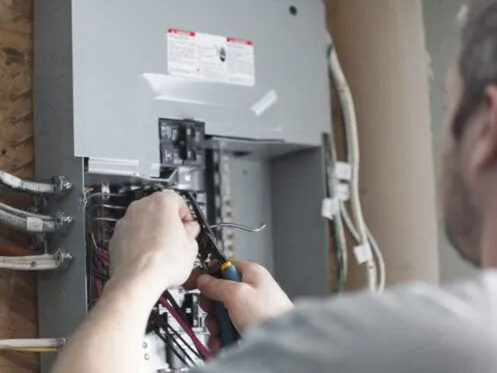

If your home still has an old-fashioned fuse box, you may be wondering whether it’s safe, how much replacement costs, and whether your homeowners insurance company will require an upgrade. These are common concerns for owners of older homes, particularly in established neighborhoods throughout Minneapolis, St. Paul, Forest Lake, and the surrounding Twin Cities.
Fuse box replacement typically costs between $1,500 and $4,000, although larger electrical service upgrades, outdated wiring, and other complications can push the total above $5,000. Replacing a fuse box with a modern circuit breaker panel can improve electrical safety, make power restoration more convenient, and help address insurance concerns. As always, these are just estimates, if you’re looking for an exact quote, be sure to reach out by calling (612) 295-1595.
But an older fuse box doesn’t automatically mean your home’s electrical system is dangerous. The condition of the equipment, how it was installed, the size of your electrical service, and the wiring connected to it all matter.
Before scheduling a replacement, it helps to understand what you’re paying for, why insurance companies sometimes object to fuse panels, and what actually changes when you switch to circuit breakers.
What Is a Fuse Box, and How Does It Work?
A fuse box is an electrical distribution panel that uses replaceable fuses to protect individual circuits from excessive electrical current.
When too much electricity flows through a circuit, a small metal element inside the fuse melts and interrupts the flow of power. This helps prevent electrical wiring from overheating due to overloads or short circuits.
Fuse boxes were common in American homes before circuit breaker panels became the standard choice for residential electrical distribution.
Many houses built during the early and middle decades of the twentieth century still have their original fuse panels. Some continue to operate without obvious problems, while others have become unsuitable for modern household electrical demands.
Types of Fuses Found in Older Homes
Not every fuse box looks or operates the same way.
Plug fuses: These round, screw-in fuses resemble small light bulbs. They were commonly used to protect 120-volt branch circuits serving lights and outlets.
Cartridge fuses: These cylindrical fuses fit into dedicated holders or pullout blocks. They may protect larger appliances, feeders, or the main electrical supply.
Type S fuses: These rejection-base fuses use adapters designed to prevent someone from installing a fuse with an amperage rating higher than the circuit permits.
A properly installed fuse can provide effective overcurrent protection. The problem arises when the fuse is incorrectly sized, connections deteriorate, or homeowners attempt to bypass the protection.
For example, installing a 30-amp fuse on a circuit designed for 15 amps can allow excessive current to flow through the wiring before the fuse opens. That creates a serious overheating and fire hazard.
How Is a Fuse Box Different From a Circuit Breaker Panel?
Both fuse boxes and circuit breaker panels protect electrical circuits from excessive current. The primary difference is how that protection operates.
A fuse contains an element that melts when its rated operating conditions are exceeded. Once the fuse opens, it must be replaced.
A circuit breaker uses a mechanical switching mechanism and an overcurrent trip system. After the underlying electrical problem has been corrected, the breaker can usually be reset.
Modern electrical panels also offer additional protection options, including arc-fault circuit interrupters (AFCIs) and ground-fault circuit interrupters (GFCIs), where required.
| Feature | Fuse Box | Circuit Breaker Panel |
| Overcurrent protection | Replaceable fuses | Resettable breakers |
| Restoring power | Replace the blown fuse | Reset the tripped breaker after resolving the problem |
| Circuit capacity | Often limited in older installations | Available in many configurations |
| AFCI and GFCI options | May require separate devices or upgrades | Compatible protective breakers available |
| Insurance acceptance | May require additional underwriting review | Generally more widely accepted |
| Maintenance | Correct replacement fuses required | No routine fuse replacement |
| Expansion | Often difficult with older equipment | Usually easier when capacity is available |
Circuit breakers aren’t inherently superior to correctly installed fuses at interrupting fault current. The advantages of a modern breaker panel come primarily from its convenience, available protective features, serviceability, and ability to accommodate contemporary electrical installations.
How Much Does Fuse Box Replacement Cost?
The cost to replace a fuse box depends on whether you’re simply changing the distribution panel or upgrading the home’s electrical service at the same time.
For many residential properties, a straightforward fuse box-to-breaker conversion falls between $1,500 and $4,000.
However, an older house with a small electrical service, deteriorated conductors, or an outdated meter installation may require more extensive work.
Average Fuse Box Replacement Costs
The following estimates provide general budgeting ranges for residential electrical projects.
| Electrical Project | Estimated Cost |
| Basic fuse box replacement with breaker panel | 1,500–3,000 |
| Fuse box conversion with a 100-amp panel | 1,800–3,500 |
| Fuse box replacement with a 200-amp service upgrade | 2,500–5,500 |
| Complex service and panel replacement | 4,000–8,000+ |
| Additional branch-circuit wiring corrections | 200–1,000+ per circuit |
| Whole-home rewiring | 8,000–20,000+ |
These ranges are planning estimates rather than fixed local prices. Actual costs in Minnesota depend on the property’s existing electrical system, required materials, labor, permits, utility coordination, and inspection requirements.
A homeowner replacing a small fuse panel in an accessible basement may face a very different project from someone upgrading an older electrical service with an exterior meter, overhead service entrance, and deteriorated wiring.
If you need an accurate estimate, be sure to give us a call. (612) 295-1595.
What Affects the Cost of Replacing a Fuse Box?
Several factors have a direct impact on the final estimate.
Existing Electrical Service Size
Older homes may have 60-amp or 100-amp electrical service.
A 60-amp service can be inadequate for many modern households, particularly those using electric cooking equipment, clothes dryers, air conditioning, electric heating, or electric vehicle chargers.
If the existing service is too small, replacing the fuse panel alone won’t solve the capacity problem.
An electrician may recommend upgrading the service to 100, 150, or 200 amps, depending on a calculated electrical load and the home’s future needs.
Condition of the Existing Wiring
A new breaker panel must be compatible with the circuits connected to it.
Older wiring may contain damaged insulation, missing equipment grounding conductors, improper splices, or other conditions requiring correction.
A panel replacement does not automatically mean every circuit needs rewiring. However, unsafe or incompatible wiring cannot simply be ignored because the panel is new.
Panel Location and Accessibility
An accessible electrical panel in an unfinished basement is generally easier to replace than equipment installed in a cramped utility closet or an unsuitable location.
If the existing fuse box lacks required working clearance or is located somewhere prohibited for a new panel, relocation may be necessary.
Moving the panel can increase labor costs and require extending existing circuits.
Permits and Electrical Inspections
Fuse box replacement typically requires an electrical permit and inspection.
Minnesota electrical installations are subject to the applicable state electrical code and local inspection procedures.
A properly permitted installation helps establish that the work was reviewed for compliance with applicable requirements.
Utility Company Requirements
When the project involves replacing the main service equipment, the electrical contractor may need to coordinate with the utility company.
Depending on the installation, additional work may involve the meter socket, service entrance conductors, grounding and bonding, or overhead and underground service connections.
These items can substantially change the project cost.
Does Homeowners Insurance Cover Fuse Box Replacement?
Homeowners insurance generally does not pay to replace a functioning fuse box simply because it’s old.
Insurance policies are designed primarily to cover qualifying losses caused by covered events, not routine maintenance or equipment modernization.
However, the circumstances surrounding the replacement can affect whether any portion of the expense qualifies for coverage.
When Insurance May Pay for Electrical Panel Replacement
If a covered event damages the fuse box, your insurance policy may provide coverage for necessary repairs or replacement.
Examples can include certain fire, lightning, or storm-related electrical damage claims.
Coverage depends on the cause of the damage, the policy’s exclusions, deductibles, and applicable limits.
For instance, if lightning damages electrical distribution equipment and the loss is covered, the insurer may pay for qualifying repairs.
That is different from replacing a functioning 60-year-old fuse box because you want a modern breaker panel.
When Insurance Usually Won’t Cover Replacement
Insurance generally does not cover fuse box replacement when the work is necessary because of:
- Normal wear and deterioration
- Outdated equipment that still functions
- Insufficient electrical capacity
- Routine maintenance
- A voluntary home improvement
- A planned renovation or appliance installation
An insurance company requiring you to replace a fuse panel does not necessarily mean it will pay for the upgrade.
In most situations, the homeowner is responsible for meeting the insurer’s underwriting requirements.
Can You Get Homeowners Insurance With a Fuse Box?
Yes. Some insurance companies insure homes with fuse boxes, although others restrict coverage or require electrical upgrades.
There is no universal rule stating that every home with fuses is uninsurable.
An insurer may evaluate the age and condition of the electrical equipment, the home’s wiring, prior electrical problems, and the type of fuse protection installed.
Some companies may request an inspection before issuing or renewing coverage.
Why Insurance Companies Are Concerned About Old Fuse Boxes
The concern isn’t simply that fuses are old technology.
Insurance underwriters may associate older fuse panels with electrical systems that have not been modernized for decades.
Potential concerns include:
- Oversized fuses installed on undersized wiring
- Overloaded branch circuits
- Deteriorated electrical connections
- Unapproved modifications
- Inadequate electrical service capacity
- Obsolete equipment and replacement parts
- Older wiring that may have additional safety issues
A fuse panel in excellent condition may present a different risk profile from one containing burned contacts, improvised repairs, or incorrect fuses.
Still, insurers establish their own underwriting standards and may decline certain types of electrical equipment regardless of its apparent condition.
What Happens If Your Insurance Company Requires Fuse Box Replacement?
If your insurer identifies the fuse box as an underwriting concern, it may issue a notice requiring corrective action within a specified period.
The notice may request replacement of the fuse panel with a modern circuit breaker panel.
In some cases, the company may also require corrections to electrical wiring, grounding, or other identified defects.
The best approach is to obtain the insurer’s requirements in writing before scheduling the project.
An electrician can then evaluate the existing system and determine what work is necessary.
After the replacement, the insurer may request documentation such as an electrical inspection record, paid invoice, or photographs of the completed installation.
Completing the required work can help satisfy the insurer’s conditions, but acceptance and continued coverage remain subject to its underwriting decision.
Can an Insurance Company Cancel Your Policy Because of a Fuse Box?
An insurer may decline a new policy, refuse renewal, or pursue cancellation when permitted by applicable law and policy terms.
Minnesota has rules governing insurance cancellation and nonrenewal, including notice requirements.
An older fuse box does not automatically authorize immediate cancellation in every situation.
If you receive a notice, review the stated reason, the effective date, and any opportunity to correct the condition.
Addressing the issue promptly gives you more time to arrange an electrical inspection and complete necessary improvements.
Should You Replace an Old Fuse Box With Circuit Breakers?
For many homeowners, switching from a fuse box to a modern breaker panel is a worthwhile improvement.
The decision should be based on the condition of the existing equipment, electrical demand, insurance requirements, and anticipated home improvements.
A properly functioning fuse box isn’t automatically an emergency. However, it may be increasingly difficult to maintain, expand, or insure.
Signs Your Fuse Box Needs Replacement
Several conditions suggest that an electrician should inspect the equipment.
Fuses blow frequently. Repeatedly blown fuses may indicate overloaded circuits, short circuits, ground faults, or defective equipment.
You notice burning odors. A hot or burning smell near the fuse panel may indicate overheating or damaged electrical connections.
The panel shows scorch marks. Discoloration, melted components, or visible heat damage requires prompt professional attention.
Lights flicker or dim unexpectedly. These symptoms can result from loose connections, overloaded circuits, or problems elsewhere in the electrical system.
You rely on extension cords throughout the house. A lack of suitable outlets or dedicated circuits may indicate that the home’s electrical distribution needs updating.
Your insurer requires an upgrade. Insurance requirements may make replacement necessary even when the existing equipment appears functional.
You’re planning major electrical improvements. New appliances, home additions, and EV charging equipment may require additional circuits or increased service capacity.
If the panel is smoking, sparking, or producing a strong burning odor, stay clear of the equipment and arrange emergency electrical assistance. Do not remove covers or attempt repairs.
Benefits of Switching From a Fuse Box to Circuit Breakers
Easier Power Restoration
When a fuse blows, the correct replacement fuse must be available.
With a circuit breaker panel, a tripped breaker can usually be reset after the problem has been identified and corrected.
This eliminates the need to maintain a supply of replacement fuses.
A breaker that trips repeatedly still requires troubleshooting. Continuously resetting it without identifying the cause can leave a dangerous electrical fault unresolved.
More Options for Electrical Protection
Modern breaker panels support protective devices that may not be practical to incorporate into older fuse installations.
AFCI protection is designed to detect certain electrical arcing conditions that can contribute to fires.
GFCI protection responds to ground-fault current imbalances and helps reduce the risk of electric shock.
These protections are required in various locations and circumstances under applicable electrical codes.
A modern panel can make it easier to provide appropriate protection as circuits are installed or modified.
Better Support for Additional Circuits
Older fuse boxes often have limited space for additional circuits.
Modern panels are available with more circuit positions, making it easier to accommodate electrical improvements when sufficient service and panel capacity exist.
Examples include dedicated circuits for kitchen appliances, basement renovations, workshops, outdoor equipment, and additional living spaces.
Improved Electrical System Organization
A properly installed breaker panel should have clearly identified circuits.
This makes it easier to isolate power when servicing outlets, lighting fixtures, or appliances.
It also helps electricians troubleshoot problems without unnecessary disruption to unrelated areas of the home.
Greater Flexibility for Future Improvements
Many older homes were designed around relatively modest electrical demands.
Today, homeowners may want central air conditioning, additional kitchen appliances, outdoor lighting, home offices, or EV charging.
A properly designed electrical upgrade can help accommodate those needs without relying on overloaded circuits or temporary wiring arrangements.
Is a 100-Amp or 200-Amp Breaker Panel Better?
One of the most important decisions during fuse box replacement is choosing the appropriate electrical service capacity.
Many homeowners assume that 200 amps is automatically necessary because it’s common in newer houses.
That isn’t always the case.
The correct size depends on the home’s calculated electrical load, existing service equipment, and anticipated additions.
When a 100-Amp Electrical Panel May Be Enough
A 100-amp service may be adequate for a smaller home with moderate electrical demand.
For example, a house with gas heating, gas cooking, and limited large electrical loads may operate comfortably with a properly designed 100-amp service.
However, square footage alone doesn’t determine electrical requirements.
An electrician must consider the connected loads and applicable demand calculations.
When a 200-Amp Service Upgrade Makes Sense
A 200-amp service may be appropriate when a home has substantial electrical demand or planned additions.
Potential factors include:
- Electric heating or heat pumps with significant auxiliary heat
- Multiple large electric appliances
- Electric vehicle charging
- Electric water heating
- Major additions or renovations
- Additional HVAC equipment
- Workshops with substantial electrical loads
Consider an older Forest Lake home with a 60-amp fuse box.
The owners plan to install central air conditioning, remodel the kitchen, and add a Level 2 EV charger.
Simply replacing the old fuse box with a 100-amp breaker panel might not provide adequate capacity for the proposed improvements.
A load calculation could show that a larger service is appropriate. Alternatively, certain load-management equipment may help accommodate specific loads without increasing the service size.
The key is designing the electrical system around actual requirements rather than selecting a panel based on assumptions.
Does a 200-Amp Panel Automatically Give You 200-Amp Service?
No. The electrical service capacity depends on the rating and configuration of the entire service installation, including the service conductors and associated equipment.
Installing a panel rated for 200 amps does not independently increase a home’s electrical service to 200 amps.
The service must be evaluated and upgraded where necessary.
This distinction is especially important when comparing electrical contractor estimates.
What Happens During a Fuse Box-to-Breaker Conversion?
Replacing a fuse box is more involved than removing old equipment and attaching a new panel.
The electrician must verify that the replacement equipment is appropriate for the electrical system and that existing circuits can be connected safely.
Step 1: Inspect the Existing Electrical System
The process begins with an evaluation of the fuse panel, service equipment, grounding and bonding, and branch-circuit wiring.
The electrician looks for overheating, damaged conductors, improper fuse ratings, unsafe modifications, and other deficiencies.
The assessment also identifies whether the existing service can support the proposed panel.
Step 2: Calculate Electrical Demand
If the project includes a service upgrade or additional electrical loads, the electrician performs the appropriate load calculations.
This helps determine whether the existing service is sufficient or whether additional capacity is needed.
Planning ahead can prevent unnecessary repeat work.
For example, a homeowner considering an EV charger within the next year should mention that during the initial evaluation.
Step 3: Obtain Permits and Coordinate the Shutdown
Electrical panel replacement normally requires a permit.
If the work involves the main service, coordination with the utility may be necessary to disconnect and restore power.
The electrician should explain the anticipated outage and inspection process before beginning the installation.
Step 4: Remove the Existing Fuse Equipment
After the electrical supply has been properly disconnected and verified safe, the old fuse equipment is removed.
The electrician evaluates the existing conductors and prepares the installation for the new panel.
Any damaged or unsuitable wiring must be addressed.
Step 5: Install the Circuit Breaker Panel
The replacement panel is installed with compatible circuit breakers, appropriate conductor terminations, and the required grounding and bonding arrangements.
Existing branch circuits are connected to their designated breakers.
Where required, appropriate AFCI or GFCI protection is incorporated.
The panel is also labeled so individual circuits can be identified.
Step 6: Test and Inspect the Installation
Before the project is completed, the electrician checks the installation and verifies proper operation.
Required inspections are completed through the appropriate authority.
Once the installation is approved and power is restored, the homeowner can operate the electrical system normally.
How Long Does Fuse Box Replacement Take?
A straightforward residential fuse box replacement may take approximately four to eight hours of on-site electrical work.
More complicated projects can take a full day or longer.
If the replacement includes a new meter socket, service entrance conductors, panel relocation, or significant wiring corrections, the project may require additional workdays.
Utility scheduling and inspection availability can also affect the overall timeline.
Homeowners should distinguish between the electrician’s installation time and the total period during which electricity will be unavailable.
A qualified electrical contractor can provide a more accurate outage estimate after evaluating the property.
Do You Have to Rewire Your House When Replacing a Fuse Box?
Not necessarily.
A fuse box replacement does not automatically require complete home rewiring.
If the existing branch-circuit wiring is in acceptable condition and can be connected safely to the new equipment, much of it may remain in service.
However, some older wiring systems require additional attention.
Knob-and-Tube Wiring
Knob-and-tube wiring is found in some older homes and uses separate conductors supported by ceramic components.
Its condition, modifications, insulation exposure, and compatibility with modern electrical demands must be evaluated.
Some insurers restrict coverage for homes containing active knob-and-tube wiring.
Replacing the fuse box does not eliminate those concerns.
Ungrounded Electrical Circuits
Older homes may have two-wire branch circuits without equipment grounding conductors.
A modern breaker panel does not automatically convert these circuits into grounded wiring.
There are code-compliant approaches for certain receptacle replacements involving GFCI protection and proper labeling, but GFCI protection does not create an equipment ground.
Where grounding is needed, additional wiring may be required.
Aluminum Branch-Circuit Wiring
Some homes built or remodeled during the 1960s and 1970s contain solid aluminum branch-circuit wiring.
Connections involving older aluminum wiring require particular attention because incompatible devices or improper terminations can create overheating hazards.
An electrician should assess the wiring and determine whether approved repair methods or replacement are appropriate.
Damaged or Deteriorated Wiring
Cracked insulation, overheating, improper splices, and damaged conductors may require electrical repairs.
In some situations, targeted repairs are sufficient.
In others, extensive wiring and rewiring may be the better long-term solution.
The goal is to correct actual deficiencies rather than automatically replacing every wire simply because the electrical panel is old.
Can You Replace a Fuse Box Yourself?
Fuse box replacement should be performed by a properly licensed electrical contractor.
Electrical panels contain equipment connected to the main power supply. Certain components can remain energized even when a main disconnect is switched off.
Working on these systems without the proper training, tools, and procedures creates serious risks of electric shock, arc flash, fire, and equipment damage.
The project also involves technical requirements beyond attaching wires to circuit breakers.
These include conductor sizing, equipment ratings, grounding, bonding, overcurrent protection, torque specifications, and code compliance.
Minnesota electrical licensing and permitting requirements also apply.
For homeowners in Forest Lake and the Twin Cities, hiring a qualified electrician provides a safer and more reliable approach to this type of work.
Common Fuse Box Problems That Shouldn’t Be Ignored
Not every electrical problem requires complete panel replacement.
Some issues can be corrected through professional electrical troubleshooting or targeted repairs.
Others indicate that the existing equipment has reached the point where replacement is the more appropriate solution.
A Fuse Keeps Blowing
A repeatedly blown fuse may indicate an overloaded circuit or an electrical fault.
For example, running a portable space heater and another high-wattage appliance on the same circuit can exceed its capacity.
Replacing the fuse with a higher-rated one is not a safe solution.
An electrician can identify the circuit load and determine whether a new dedicated circuit is necessary.
A Fuse Holder Feels Hot
Excessive heat at a fuse holder may result from a loose connection, damaged contacts, or an overloaded circuit.
Heat damage can worsen over time and may create a fire hazard.
A hot fuse holder should be evaluated promptly rather than repeatedly used.
Lights Flicker Throughout the House
Flickering lights can have several causes, including loose connections, voltage fluctuations, or problems with the electrical service.
When the issue affects multiple circuits, it may originate at the main panel, service connections, or utility supply.
An electrician can determine whether the fuse box is responsible or whether the problem is elsewhere.
Outlets Stop Working
A blown fuse can interrupt power to multiple outlets on the same circuit.
However, damaged receptacles, loose connections, and wiring faults can produce similar symptoms.
Professional electrical repair can help identify the cause and restore power safely.
Should You Replace Your Fuse Box Before Selling Your House?
Replacing an old fuse box before selling a home can make sense, particularly when the electrical system is likely to create financing, insurance, or inspection concerns.
Homebuyers may hesitate when they discover that a property still has outdated electrical equipment.
Some buyers will request an electrical inspection or ask for replacement as part of negotiations.
Others may have difficulty obtaining acceptable homeowners insurance.
A modern breaker panel can remove one potential obstacle during the transaction.
However, a fuse box replacement does not guarantee a higher selling price or eliminate every electrical concern.
If the house contains outdated wiring, ungrounded circuits, or other defects, those conditions may still appear in the inspection report.
A pre-listing electrical inspection can help homeowners determine whether replacement is necessary and which improvements deserve priority.
Does Replacing a Fuse Box Increase Home Value?
Fuse box replacement may improve a property’s marketability, but the financial return depends on the condition of the home and local buyer expectations.
Unlike a kitchen renovation or bathroom remodel, an electrical panel upgrade is primarily an infrastructure improvement.
Buyers may not assign a large visible premium to a new panel, but they may discount a property with electrical equipment that needs immediate attention.
The practical value comes from reducing potential safety concerns, supporting modern electrical demands, and making the property easier to maintain and insure.
For an older Twin Cities home, those benefits can be significant even when they don’t translate into a dollar-for-dollar increase in resale value.
Electrical Improvements Worth Considering During Fuse Box Replacement
Replacing an outdated fuse panel creates an opportunity to evaluate other parts of the electrical system.
It doesn’t mean every improvement needs to happen at once. However, coordinating certain projects may reduce duplicate labor and make future upgrades easier.
Whole-Home Surge Protection
Modern homes contain sensitive electronics in appliances, heating and cooling equipment, computers, and entertainment systems.
A whole-home surge protective device helps limit certain transient overvoltages that can damage connected equipment.
Surge protection does not prevent every type of electrical damage, but it adds an important layer of protection.
When replacing the main panel, homeowners can ask about whole-home surge protection and whether the installation requires it under the applicable electrical code.
Additional Outlets and Dedicated Circuits
Older homes often have fewer outlets than modern households need.
Adding properly located receptacles can reduce reliance on extension cords and power strips.
Dedicated circuits may also be appropriate for appliances with substantial electrical demands.
For example, a basement renovation might require new receptacles, lighting circuits, and separate power for certain equipment.
Planning these improvements alongside the panel replacement can simplify the overall project.
Indoor and Outdoor Lighting
A new electrical panel can provide a convenient starting point for planned lighting improvements.
Homeowners may want recessed lighting, upgraded kitchen lighting, exterior security fixtures, or additional landscape lighting.
The electrician can determine whether existing circuits are adequate or whether new wiring is necessary.
EV Charging Installation
Electric vehicle charging is an increasingly important consideration when evaluating residential electrical capacity.
A Level 2 home charging installation may require a dedicated 240-volt circuit, depending on the charging equipment.
The electrical service must have sufficient capacity for the proposed load or an appropriate load-management solution.
If you’re considering an electric vehicle, discussing charging requirements before selecting a replacement panel can help avoid unnecessary future upgrades.
Fuse Box Replacement in Older Twin Cities Homes
Many homes throughout Minneapolis, St. Paul, Forest Lake, White Bear Lake, Roseville, Stillwater, and nearby communities were constructed when residential electrical demands were substantially different from today’s.
A home originally equipped with a modest fuse panel may now have central air conditioning, multiple televisions, computers, modern kitchen appliances, and other electrical loads.
Some older houses have also undergone additions or renovations without a comprehensive evaluation of the original electrical service.
Minnesota’s climate creates additional considerations.
Cold winters increase the importance of dependable heating equipment and electrical connections. Homes with electric heating, heat pumps, or auxiliary heating elements may have substantial electrical demand.
Outdoor service equipment also experiences seasonal temperature changes, moisture, and other environmental conditions.
These factors make a thorough inspection particularly valuable when planning a fuse box replacement.
Choosing an Electrician for Fuse Box Replacement
Before hiring an electrical contractor, ask whether the estimate includes the full scope of the project.
A useful written proposal should identify the proposed panel, service rating, required electrical corrections, permit responsibilities, and any anticipated utility coordination.
It should also clarify whether the contractor is replacing only the distribution panel or upgrading the complete electrical service.
Two estimates can differ substantially because they include different work.
For example, one proposal may cover a panel-only conversion while another includes a new meter socket, service entrance wiring, grounding improvements, and additional circuit protection.
Comparing those estimates solely by price would be misleading.
An experienced electrician should explain why the proposed work is necessary and how it addresses the home’s existing conditions.
Professional Fuse Box Replacement in Forest Lake and the Twin Cities
When an older fuse box no longer meets your electrical needs, choosing the right replacement requires more than selecting a larger panel.
The existing wiring, service capacity, electrical loads, and future improvements all need to work together.
Plugz Electric provides electrical panel replacement and repair services for homeowners in Forest Lake and throughout the Twin Cities Metro area.
Our electricians evaluate existing electrical systems, identify potential problems, and recommend improvements based on the property’s actual needs.
Whether you’re replacing an outdated fuse panel, addressing an insurance requirement, or planning a larger electrical upgrade, we can help determine an appropriate solution.
Plugz Electric also provides electrical repairs, wiring and rewiring, outlet installation, surge protection, indoor and outdoor lighting, and EV charging installations.
If you’re unsure whether your old fuse box needs replacement, schedule an electrical assessment before making a decision.
Contact Plugz Electric at (612) 295-1595 or visit our contact page to discuss fuse box replacement in Forest Lake, Minneapolis, St. Paul, and surrounding communities.
Frequently Asked Questions About Fuse Box Replacement
How much does it cost to replace a fuse box with circuit breakers?
Replacing a residential fuse box with a circuit breaker panel typically costs between $1,500 and $4,000. Projects involving a 200-amp service upgrade, meter replacement, panel relocation, or extensive wiring repairs may cost $5,000 or more. An on-site electrical inspection is the best way to establish the actual replacement cost.
Is it illegal to have a fuse box in your house?
No. Having an existing fuse box is not automatically illegal. Properly installed older electrical equipment may remain in service, depending on its condition and applicable requirements. However, modifications, unsafe conditions, or insurance requirements may make replacement necessary.
Are fuse boxes a fire hazard?
A properly installed and maintained fuse box is not inherently a fire hazard. Problems arise when equipment deteriorates, connections overheat, circuits are overloaded, or incorrect fuses are installed. Older fuse panels should be evaluated for these conditions, especially if there are signs of overheating or repeated electrical problems.
Will homeowners insurance cover fuse box replacement?
Homeowners insurance generally does not cover replacement due to age, normal wear, or a voluntary electrical upgrade. Coverage may apply when the equipment is damaged by a covered event, such as certain lightning or fire losses. The policy terms and cause of damage determine whether the claim qualifies.
Can homeowners insurance refuse coverage because of a fuse box?
Yes. Some insurers restrict or decline coverage for homes with certain older electrical systems. Others may require an inspection or replacement before issuing or renewing a policy. Requirements vary by insurance company and the condition of the installation.
How much does it cost to upgrade from a 60-amp fuse box to 200 amps?
Upgrading a 60-amp electrical service to 200 amps commonly costs approximately $2,500 to $5,500, although complex projects can exceed that range. The final cost depends on the service entrance, meter equipment, grounding and bonding, panel location, utility requirements, and existing wiring.
Is it worth replacing an old fuse box?
Replacing an old fuse box is often worthwhile when the equipment is deteriorating, circuits are frequently overloaded, additional circuits are needed, or an insurance company requires an upgrade. A modern breaker panel also provides more convenient circuit control and supports contemporary electrical protection options.
How long does it take to replace a fuse box with a breaker panel?
A straightforward fuse box replacement may require four to eight hours of electrical work. More complicated installations involving service upgrades or wiring corrections can take longer. Utility coordination and inspections may affect the total project timeline.
Can you change a fuse box to a breaker box without rewiring the house?
Yes. If the existing branch-circuit wiring is in suitable condition and compatible with the replacement equipment, it may be possible to install a breaker panel without completely rewiring the house. Damaged, unsafe, or incompatible wiring may still require correction.
Does a new breaker panel make old wiring safe?
No. A new electrical panel improves the distribution equipment, but it does not automatically correct defects in existing branch-circuit wiring. Problems such as damaged insulation, improper connections, or missing equipment grounds may require separate electrical work.
Do I need a 200-amp panel when replacing my fuse box?
Not necessarily. The appropriate service capacity depends on a calculated electrical load and the home’s current and anticipated needs. Some homes can operate adequately with 100-amp service, while others benefit from a 200-amp upgrade. An electrician can determine the appropriate capacity.
Can I replace a fuse box myself in Minnesota?
Electrical panel replacement involves hazardous service equipment and must comply with applicable Minnesota electrical licensing, permitting, and inspection requirements. Hiring a licensed electrical contractor is the appropriate choice for a fuse box-to-breaker conversion.
Does replacing a fuse box require a permit?
Yes, electrical panel replacement generally requires an electrical permit and inspection in Minnesota. The applicable inspection authority depends on the property’s location. Your electrical contractor should identify the requirements and arrange the necessary approvals.
What happens if I don’t replace an old fuse box?
If the fuse box is in acceptable condition and meets your electrical needs, immediate replacement may not be necessary. However, deteriorated equipment, inadequate circuit capacity, improper fuses, or insurance requirements should not be ignored. Delaying necessary repairs can increase safety risks and create insurance or property-sale complications.
Can I sell a house that still has a fuse box?
Yes. A home can be sold with an existing fuse box, but the electrical system may become a concern during inspections, insurance underwriting, or buyer negotiations. Replacing outdated equipment before listing can help address some of these issues.
Will a new breaker panel lower my homeowners insurance premium?
Possibly, but a lower premium is not guaranteed. Some insurers may view a modern electrical panel more favorably than older fuse equipment. Others may simply require the upgrade as a condition of coverage. Ask your insurance company whether the completed work affects eligibility or premiums.
What is the difference between replacing a fuse box and upgrading electrical service?
Fuse box replacement involves changing the electrical distribution equipment, typically to a modern breaker panel. An electrical service upgrade increases or otherwise modifies the capacity of the home’s incoming electrical supply and may require additional equipment and wiring. The two projects are often performed together, but they are not the same.
Who replaces fuse boxes near Forest Lake, MN?
Plugz Electric provides electrical panel replacement and electrical upgrade services in Forest Lake and surrounding Twin Cities communities. Our electricians can inspect an existing fuse box, assess electrical capacity, identify wiring concerns, and recommend an appropriate breaker panel replacement. Call (612) 295-1595 to schedule an evaluation.