
A light that flickers once may not seem important. Maybe the bulb is getting old, or it was not screwed in tightly enough. When lights continue flickering, dim whenever an appliance starts, or begin acting strangely in several rooms, however, the cause deserves a closer look.
So, what causes flickering lights? The answer can range from something as simple as a loose bulb to problems involving switches, overloaded circuits, deteriorating wiring, electrical panels, or the incoming electrical service.
The pattern usually provides the first clue. One flickering lamp is very different from every light in the house, suddenly changing brightness. Knowing those differences can help homeowners determine whether they are dealing with a lighting problem or a symptom of a larger electrical issue.
Why Do Lights Flicker?
Electric lights need a consistent electrical connection and a suitable voltage to operate normally. Anything that interferes with that supply can cause a visible change in the light output.
Depending on the underlying problem, you might notice:
- Rapid flickering or fluttering
- Lights that occasionally blink off
- A bulb that changes brightness
- Lights that dim when an appliance turns on
- Flickering is limited to one fixture
- Several lights are flickering on the same circuit
- Lights flickering throughout the entire house
The distinction matters because flickering is a symptom rather than a diagnosis. Before replacing fixtures or assuming there is a serious wiring problem, it helps to determine where and when the problem occurs.
Common Causes of Flickering Lights
There is no single explanation that applies to every home. Electricians typically narrow down the problem by looking at the affected fixtures, circuits, electrical load, wiring connections, and panel.
A Loose or Failing Light Bulb
Start with the simplest possibility.
A bulb that is not seated securely in its socket can make intermittent electrical contact. As the connection changes, the light may flicker, blink, or temporarily shut off.
If only one fixture is affected, turn the light off, allow the bulb to cool, and make sure it is installed properly. If tightening it solves the problem, further electrical work may not be necessary.
An aging bulb can produce similar symptoms. Testing the fixture with a known-good bulb is an easy way to determine whether the bulb itself is responsible.
If a new bulb continues flickering, the problem is likely somewhere else.
An Incompatible LED Bulb and Dimmer Switch
LED lighting has made flickering problems somewhat more complicated.
Older dimmer switches were commonly designed around incandescent bulbs, which behave differently from LEDs. Installing dimmable LEDs on an incompatible dimmer can result in flashing, buzzing, limited dimming range, or flickering at certain brightness settings.
Even a new dimmer can create problems if the bulb and dimmer are not compatible.
If the flickering only occurs when lights are dimmed, check whether:
- The LED bulbs are rated as dimmable.
- The dimmer is designed for LED lighting.
- The bulbs are compatible with that particular dimmer.
- The total lighting load falls within the dimmer’s operating range.
Replacing an outdated light switch or installing a properly matched LED dimmer can often resolve this type of problem.
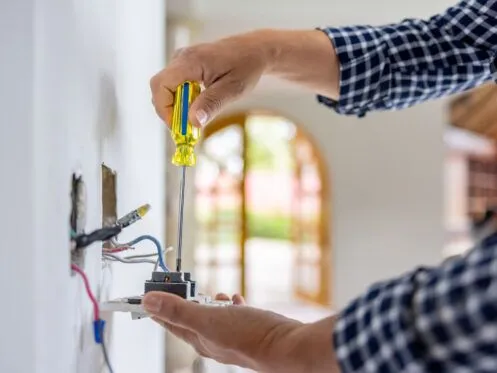
A Worn or Faulty Light Switch
The bulb is not always responsible. The switch controlling it may be the weak point.
Light switches contain electrical contacts that wear over time. A damaged or deteriorating switch may stop maintaining a reliable connection, leading to intermittent lighting.
One useful clue is whether the flickering changes when the switch is touched or moved. If a light flashes when you operate the switch, the switch feels unusually loose, or you hear crackling or buzzing from it, the device should be inspected.
A switch that feels warm or produces a burning odor requires more immediate attention.
A Loose Connection at the Fixture
Electrical connections exist behind the visible parts of a light fixture. If one of those connections loosens, the fixture may receive intermittent power.
This is one reason replacing the bulb does not always solve a flickering light.
Connections can loosen because of age, previous installation problems, vibration, heat cycles, or deterioration. Ceiling fixtures and ceiling fans are particularly noticeable when a connection issue causes intermittent operation.
Because diagnosing the problem requires accessing electrical connections, this is generally the point where professional electrical repair makes more sense than continuing to experiment with different bulbs.
Why Do My Lights Flicker When an Appliance Turns On?
This is one of the most common versions of the problem.
A large appliance or electrical device can draw significantly more current when it first starts. Air conditioners, refrigerators, sump pumps, power tools, microwaves, and other equipment with motors or compressors may create a temporary voltage drop.
A very brief, minor dimming event does not automatically indicate a major problem. Frequent or pronounced flickering is different.
High Electrical Demand
Suppose the lights dim substantially every time the air conditioner starts. That may indicate that the electrical system is experiencing a significant voltage drop when the equipment demands additional power.
The cause could involve the appliance, its circuit, connections within the electrical system, or the available electrical capacity.
Older homes deserve particular attention. Many were wired when households used considerably fewer electrical devices than they do today. Modern HVAC equipment, kitchen appliances, computers, entertainment systems, EV chargers, and other equipment can place much greater demands on an electrical system.
An Overloaded Circuit
A circuit can only safely support a certain electrical load.
When lighting and high-demand devices share a circuit, operating several devices simultaneously may cause voltage fluctuations or eventually trip the circuit breaker.
Repeated overloads should not simply be treated as an inconvenience. An electrician can determine how the circuit is being used and whether loads should be redistributed or additional circuits installed.
Loose Electrical Wiring Can Cause Lights to Flicker
Loose wiring is one of the more serious potential causes of flickering lights.
Unlike a loose bulb, the poor connection may be hidden inside a junction box, outlet, switch box, fixture, or electrical panel. Loose connections can create resistance and heat. In some circumstances, they can also contribute to electrical arcing.
The location of the flickering can help narrow the search.
If one fixture flickers, the issue may be local to that fixture or switch. If several lights on one circuit flicker together, the problem may be farther upstream. If lights throughout the house are affected, the electrical panel, service connection, or utility supply becomes more relevant.
Plugz Electric specifically identifies outdated or damaged wiring as a potential source of shorts, flickering lights, and fire hazards, which is why persistent flickering should not be ignored when the bulb and fixture are not obvious causes.
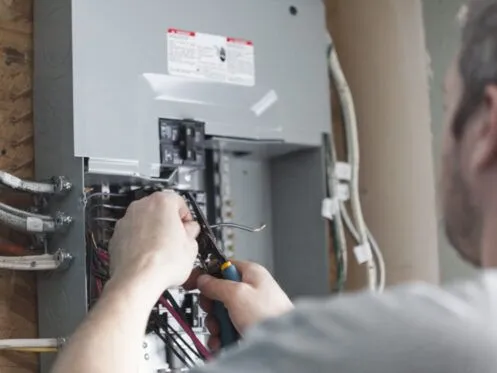
Can an Electrical Panel Cause Flickering Lights?
Yes. The electrical panel is another important area that electricians investigate when flickering affects multiple circuits or large portions of a home.
The electrical panel distributes electricity among the home’s branch circuits. Problems involving breakers, bus connections, conductors, or the service can affect the quality and reliability of the power reaching those circuits.
An Aging Electrical Panel
Electrical panels do not last indefinitely. Older equipment can develop worn components, corrosion, poor connections, or other deficiencies.
Age alone does not prove that a panel needs replacement. Its condition and ability to support the home’s electrical requirements are more important.
Plugz Electric notes that old or overloaded panels can struggle with modern household power demands and create safety concerns.
When flickering accompanies frequently tripped breakers, unusual panel noises, heat, burning odors, or evidence of deterioration, the panel should be professionally evaluated.
Loose Connections Inside the Panel
A loose connection at the panel can affect an entire circuit rather than one individual light.
This is not an appropriate DIY troubleshooting area. Removing an electrical panel cover can expose energized components even when individual branch breakers are switched off.
An electrician can test circuits, inspect connections, measure voltage, and determine whether the problem originates at the panel or elsewhere.
What Causes Flickering Lights Throughout the Entire House?
When multiple lights on different circuits begin flickering simultaneously, the problem becomes more significant.
Whole-house flickering can potentially involve:
- Electrical service connections
- A loose service conductor
- A neutral connection problem
- The main electrical panel
- Significant voltage fluctuations
- Utility-side equipment or connections
This pattern is particularly important when lights are not simply flickering but changing brightness dramatically.
A Loose or Failing Neutral Connection
A compromised neutral connection can cause abnormal voltage behavior within a residential electrical system.
One possible symptom is an unusual combination where some lights become brighter while others become dimmer. That is different from an individual LED bulb occasionally fluttering.
If lights throughout the home suddenly become unusually bright or dim, especially on different circuits, professional attention is warranted promptly.
Problems With the Utility Supply
Not every flickering-light problem begins inside the home.
Equipment and connections on the utility side can cause voltage disturbances as well. If your entire home is affected—or neighboring homes appear to be experiencing the same problem—the electrical utility may need to investigate.
An electrician can help determine whether the issue appears to originate within the home’s electrical system or upstream of it.
Can Bad Outlets Cause Flickering Lights?
They can, depending on how the circuit is wired.
Receptacles, switches, lights, and other devices may share a branch circuit. A loose or deteriorating connection at one device can potentially affect equipment farther downstream.
An outlet does not have to stop working completely to have a problem.
Warning signs around receptacles include:
- Plugs that fit loosely
- Intermittent power
- Discoloration
- Buzzing or crackling
- Unusual warmth
- A burning smell
- Visible damage
Plugz Electric provides outlet repair and installation throughout the Twin Cities Metro area and notes that worn, loose, and non-grounded outlets can create shock and electrical-fire concerns.
Can Old Wiring Make Lights Flicker?
Yes. Wiring condition becomes increasingly important in older homes or properties that have undergone multiple renovations.
The issue is not simply that wiring is “old.” The concern is whether conductors, insulation, splices, connections, and the overall electrical design remain safe and suitable for current demand.
A house may also contain modifications performed decades apart. Additions, remodeled kitchens, finished basements, new lighting, and modern appliances can place demands on circuits that were designed for a very different household.
Persistent lighting problems may therefore be one symptom of a broader wiring issue.
Plugz Electric offers electrical wiring and whole-home rewiring services in Forest Lake and across the Twin Cities Metro area, along with electrical repairs, panel work, outlets, switches, and indoor and outdoor lighting services.
Why Do LED Lights Flicker?
LEDs can reveal electrical inconsistencies that were less noticeable with traditional incandescent lighting.
Their electronic drivers react differently to changes in voltage and current. As a result, LED flickering can be caused by several factors, including:
- Incompatible dimmers
- Poor-quality or failing LED drivers
- Loose bulbs or sockets
- Faulty switches
- Voltage fluctuations
- Loose electrical connections
- Problems with smart lighting controls
The easiest way to narrow down the issue is to look for a pattern. One LED bulb behaving badly usually points toward the bulb or fixture. Several LED fixtures flickering together suggest looking farther upstream.
Why Does My Ceiling Fan Light Flicker?
Ceiling fan lights have several possible failure points because the fixture combines lighting, controls, electrical connections, and a moving motor.
A flickering fan light could result from the bulb, socket, switch, remote-control receiver, LED module, internal wiring, or the electrical connection feeding the fan.
Vibration can also make an already weak connection more noticeable.
If the light flickers only when the fan operates, or changing fan speed affects the lighting, the fixture and its controls should be inspected rather than assuming the home’s entire electrical system is responsible.
Outdoor Lights Can Flicker Too
Outdoor lighting is exposed to conditions that indoor fixtures generally avoid.
Moisture, temperature swings, corrosion, deteriorated connections, damaged fixtures, and weather exposure can all contribute to intermittent operation.
Minnesota weather makes proper outdoor electrical installation particularly important. Exterior fixtures, wiring methods, boxes, receptacles, and connections need to be appropriate for their environment.
If several outdoor fixtures are flickering or repeatedly losing power, the circuit itself may need troubleshooting. Plugz Electric provides both indoor and outdoor lighting services as part of its electrical work throughout the Twin Cities Metro area.
Are Flickering Lights Dangerous?
Sometimes.
A loose bulb is inconvenient. A deteriorating electrical connection is a different matter entirely.
The important question is what is causing the flicker.
Persistent flickering deserves greater attention when it occurs alongside other electrical warning signs, such as:
- Burning or hot-plastic odors
- Buzzing or crackling sounds
- Warm switches or outlets
- Scorch marks or discoloration
- Frequently tripping circuit breakers
- Multiple circuits behaving abnormally
- Sparks
- Sudden changes in brightness
- Intermittent power elsewhere in the house
Those symptoms point beyond an ordinary bulb problem.
How to Troubleshoot a Flickering Light
You can perform a few basic observations without opening electrical boxes or panels.
Start With the Bulb
Turn the fixture off and let the bulb cool. Make sure it is seated correctly. If necessary, replace it with a known-good bulb that meets the fixture’s specifications.
If the flickering disappears, you have likely found the cause.
Check Whether a Dimmer Is Involved
If the fixture uses LEDs and a dimmer, determine whether both are compatible.
Pay attention to whether the flickering only occurs at low brightness settings. That pattern can strongly suggest a dimmer-related problem.
Identify How Many Lights Are Affected
This is one of the most useful pieces of information you can give an electrician.
Is it:
- One bulb?
- One fixture?
- Every light controlled by one switch?
- Several lights in one room?
- Multiple rooms?
- The entire house?
The wider the problem spreads, the less likely it is that a single bulb is responsible.
Notice When the Flickering Happens
Does it occur randomly, or does something trigger it?
For example, note whether it happens when:
- The air conditioner starts
- The refrigerator compressor turns on
- A microwave operates
- A vacuum or power tool is used
- A ceiling fan changes speed
- Several appliances are running
- A particular switch is moved
Patterns help electricians isolate load-related and circuit-specific problems much more efficiently.
Do Not Open the Electrical Panel to Investigate
Homeowners can observe whether a breaker has tripped, but troubleshooting energized panel components is different.
If the evidence points toward the panel, wiring, or electrical service, that investigation should be handled by a qualified electrician.
When Should You Call an Electrician for Flickering Lights?
Call an electrician when flickering is persistent, affects several fixtures, appears to be getting worse, or cannot be traced to a simple bulb issue.
Professional electrical troubleshooting is especially appropriate when lights flicker throughout the house, breakers repeatedly trip, appliances cause severe dimming, or you notice heat, odors, buzzing, damaged devices, or other abnormal electrical behavior.
An electrician can investigate the complete circuit instead of treating the visible symptom. That may involve testing voltage, evaluating the electrical load, checking switches and receptacles, inspecting wiring connections, and assessing the panel.
Preventing Future Flickering-Light Problems
Not every lighting issue can be prevented, but a properly maintained electrical system reduces the likelihood of recurring problems.
That means replacing damaged switches and outlets rather than continuing to use them, addressing wiring deficiencies, keeping electrical loads appropriate for available circuits, and upgrading equipment when the home’s electrical demands have outgrown the existing system.
Surge protection can also be part of a broader strategy for protecting electrical equipment and sensitive electronics from voltage spikes. Plugz Electric offers whole-home surge protection in addition to panel upgrades, wiring and rewiring, lighting, outlets, switches, and electrical repair.
For renovations or new lighting installations, planning matters as well. Adding fixtures, appliances, or other electrical loads without considering the existing circuit and panel capacity can create problems later.
Professional Electrical Repair in Forest Lake and the Twin Cities Metro Area
Flickering lights are easy to dismiss because the electricity is technically still working. The better approach is to pay attention to the pattern.
A single loose bulb may take seconds to correct. Repeated flickering across a room, circuit, or entire home can indicate a problem that requires electrical troubleshooting.
Plugz Electric is based in Forest Lake and provides residential and commercial electrical services throughout the Twin Cities Metro area. Its services include electrical repairs, electrical panels, wiring and rewiring, surge protection, outlets, light switches, indoor lighting, outdoor lighting, ceiling fan installation, and other electrical upgrades.
If replacing or tightening a bulb does not solve the problem—or the flickering is accompanied by other electrical warning signs—having the system professionally inspected can identify the actual cause and determine the appropriate repair.
Need help? Give our electrical company a call at 612-295-1595 or use our online form. Don’t forget, we’re available 24/7.
Frequently Asked Questions About Flickering Lights
What is the most common cause of flickering lights?
For a single light, common causes include a loose or failing bulb, a worn socket, a faulty switch, or an incompatible LED bulb and dimmer. When multiple lights flicker together, electricians generally look beyond the bulb and investigate the circuit, wiring, panel, electrical load, and service.
Should I worry if my lights flicker?
An occasional flicker from one bulb is not necessarily serious. Persistent flickering, whole-house flickering, severe dimming, or flickering accompanied by buzzing, burning smells, warm electrical devices, sparks, or tripped breakers deserves professional attention.
Why are my lights flickering, but the breaker isn’t tripping?
Circuit breakers primarily protect against specific overcurrent and fault conditions. Not every electrical problem produces enough current to trip a breaker. A loose connection, faulty switch, failing fixture, voltage fluctuation, or neutral problem may cause visible lighting symptoms without immediately tripping the circuit breaker.
Why do my lights flicker when the AC turns on?
An air conditioner draws additional current when its compressor starts, which can cause a brief voltage drop. Slight momentary dimming can occur, but pronounced or worsening flickering should be investigated because the cause could involve the equipment, circuit, electrical connections, service capacity, or panel.
Why do LED lights flicker when dimmed?
LED lights may flicker when paired with an incompatible dimmer or when non-dimmable LED bulbs are used on a dimming circuit. A failing LED driver or electrical connection can produce similar symptoms.
Can a bad light switch cause flickering?
Yes. Worn contacts or loose connections inside a switch can interrupt the electrical connection to a fixture. Flickering that changes when you touch or operate the switch is a strong reason to have the switch inspected.
Can an overloaded electrical panel cause flickering lights?
Electrical systems experiencing high demand or inadequate capacity can develop voltage-related symptoms, including dimming or flickering. However, an electrician needs to diagnose the system to determine whether the panel itself, a circuit, a connection, an appliance, or the incoming service is responsible.
Why are all the lights in my house flickering at once?
Whole-house flickering can indicate a problem involving the main panel, service conductors, neutral connection, utility supply, or another upstream electrical connection. This is more concerning than a single flickering fixture and should not be treated as a bulb problem.
Can loose wiring cause flickering lights?
Yes. A loose electrical connection can cause intermittent power and flickering. Because loose connections may generate heat or arcing, persistent flickering associated with wiring should be investigated rather than ignored.
Why does one room have flickering lights?
If several lights in one room flicker together, they may share a circuit or connection that is experiencing a problem. If only one fixture flickers, the issue is more likely to be located at the bulb, fixture, switch, or nearby wiring.
Do flickering lights mean I need to rewire my house?
Not necessarily. Flickering can have many causes, and whole-home rewiring is only appropriate when the condition of the existing wiring justifies it. An electrician should diagnose the underlying problem before recommending extensive electrical work.
Who should I call for flickering lights in the Twin Cities?
A licensed electrician can troubleshoot persistent flickering and determine whether the cause involves the lighting fixture, switches, outlets, wiring, electrical panel, circuit loading, or another part of the electrical system. Plugz Electric serves Forest Lake and communities throughout the Twin Cities Metro area and provides electrical repairs, lighting work, wiring and rewiring, panel services, outlets, switches, and surge protection.