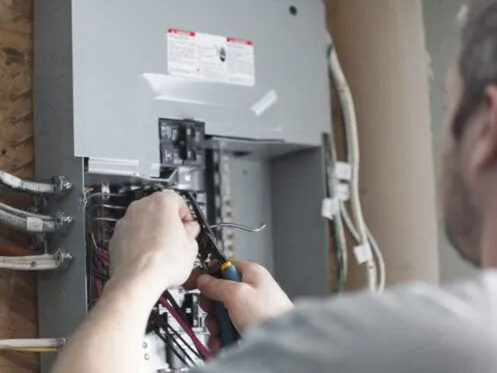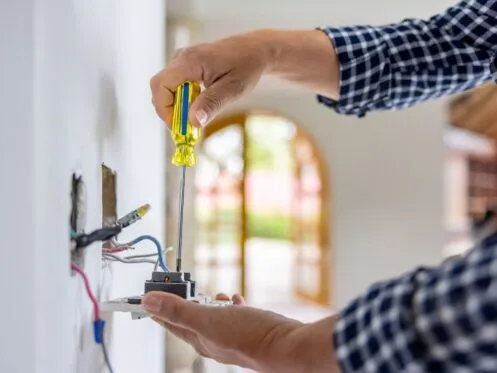

A circuit breaker can stay on while a damaged cord or loose connection creates a fire hazard. That surprises many homeowners. After all, the breaker is supposed to shut off the power when something goes wrong.
The catch is that different electrical problems need different kinds of protection. A standard breaker responds to overloads and short circuits. An arc-fault circuit interrupter, usually called an AFCI, adds protection against dangerous electrical arcing that may not draw enough current to trip a conventional breaker.
For homeowners in Forest Lake and the Twin Cities, AFCI protection matters during electrical repairs, room additions, outlet replacements, and rewiring projects. It also deserves attention when a breaker repeatedly trips without an obvious explanation.
Understanding what an AFCI does helps you make better decisions about the wiring, outlets, lighting, and electrical panel that serve your home.
What Is an Arc-Fault Circuit Interrupter?
An arc-fault circuit interrupter is a protective device designed to recognize electrical patterns associated with hazardous arcing and interrupt power to the affected circuit.
An arc occurs when electricity travels across a gap between conductive surfaces. Inside a home’s electrical system, that gap might develop at a loose connection, across damaged insulation, or within a broken appliance cord.
Arcing can generate intense, concentrated heat. If combustible material is nearby, the heat can create an ignition hazard.
AFCIs help address that risk by monitoring the circuit for characteristics of dangerous arcing. They are commonly installed as circuit breakers in the electrical panel, although outlet-based AFCI devices are also available.
The U.S. Consumer Product Safety Commission identifies AFCIs as an added layer of protection against fires caused by unsafe arcing in residential wiring. It also notes that ordinary breakers and fuses may not respond to early arcing conditions. cpsc.gov
Why a Standard Breaker May Not Detect an Arc Fault
A conventional breaker primarily responds to excessive current.
An overload happens when equipment draws more current than the circuit can safely carry over time. A short circuit can produce a much larger surge of current when conductors connect through an unintended low-resistance path.
An arc fault can behave differently. A damaged connection might produce intermittent arcing while the overall circuit current remains below the breaker’s rating.
Picture a lamp cord pinched under a heavy dresser. Some conductor strands break, but the lamp still works. Current continues through the damaged area, where an intermittent gap can create arcing.
The circuit does not necessarily become overloaded. A standard breaker may have no reason to open, even though the damaged cord needs immediate attention.
How Does an AFCI Work?
An AFCI monitors electrical activity and evaluates patterns in the current waveform. Its electronics are designed to distinguish hazardous arcing signatures from the electrical activity that occurs during normal operation.
If the device identifies a qualifying arc-fault condition, it opens the circuit and stops the flow of electricity.
That distinction matters because normal equipment operation can involve brief arcing. Switch contacts, for example, can create a small arc as they separate. AFCI design accounts for normal operating patterns rather than treating every electrical disturbance as a fire hazard.
An AFCI does not inspect the home, identify a particular damaged outlet, or repair the cause of a trip. It interrupts power. Finding and correcting the underlying problem is a separate part of electrical troubleshooting.
Series Arc Faults
A series arc fault occurs along the normal current path, such as at a broken conductor or loose connection.
Because the arc is in series with the load, the connected equipment limits the current. This helps explain why a hazardous connection can exist without tripping a standard overcurrent breaker.
Possible locations include:
- A damaged appliance cord.
- A loose conductor termination.
- A failing connection inside an electrical box.
- A partially broken wire.
Consider a receptacle with a loose connection that feeds several other outlets. The television and lamps may still operate, yet the compromised connection can become a source of intermittent arcing.
Parallel Arc Faults
A parallel arc fault occurs between conductors that should remain electrically separated, such as a hot conductor and a neutral conductor, or a hot conductor and ground.
Damaged insulation can create the conditions for this type of fault.
For example, a fastener driven into a concealed cable may damage the insulation between conductors. Depending on the damage and resulting current path, the problem may produce arcing rather than an immediate, solid short circuit.
This is one reason careful cable routing and physical protection remain essential during remodeling. AFCI protection supports safe installation practices; it does not replace them.
AFCI vs. GFCI: What Is the Difference?
An AFCI and a ground-fault circuit interrupter protect against different electrical hazards.
An AFCI looks for hazardous arcing patterns associated with electrical fires. A GFCI monitors the balance of current leaving and returning on a circuit and interrupts power when it detects an imbalance consistent with current taking an unintended path.
That unintended path could include a person, which is why GFCI protection is central to reducing shock hazards.
| Device | Primary purpose | What it monitors |
| Standard circuit breaker | Overload and short-circuit protection | Excessive current |
| AFCI | Protection against hazardous arcing | Electrical patterns associated with arc faults |
| GFCI | Protection against electric shock from ground faults | An imbalance between outgoing and returning current |
| Dual-function AFCI/GFCI | Both arc-fault and ground-fault protection | Hazardous arcing patterns and current imbalance |
An outlet near water may need GFCI protection, while the circuit serving that same room may also need AFCI protection. Kitchens and laundry areas are common places where the requirements overlap.
The solution is a compliant arrangement that provides both forms of protection. Installing one does not automatically satisfy the requirement for the other.
Combination AFCI Does Not Mean AFCI and GFCI
The wording on protective devices can be confusing.
A combination-type AFCI provides protection against both series and parallel arc faults. The word “combination” describes the arc-fault protection.
A dual-function AFCI/GFCI provides both arc-fault protection and ground-fault protection.
A combination AFCI breaker does not automatically provide personnel-level GFCI protection. Read the actual device labeling rather than relying on the presence of a test button. Leviton specifically distinguishes these terms in its product guidance. Leviton Product Support
Types of Arc-Fault Circuit Interrupters
The right AFCI arrangement depends on the panel, circuit layout, wiring method, and applicable installation requirements.
AFCI Circuit Breakers
An AFCI breaker is installed in the electrical panel at the origin of the branch circuit. It combines the breaker’s overcurrent protection with arc-fault protection.
This arrangement is often useful when installing a new circuit or upgrading an existing circuit where a suitable breaker is available.
Breaker selection requires more than matching the amperage. The device must be listed or classified for use in the specific panel, and the installation must follow the applicable instructions.
A breaker that appears to fit physically is not necessarily approved for that equipment.
AFCI Receptacles
An outlet branch-circuit AFCI is installed at an outlet location. It may look similar to a GFCI receptacle because it has test and reset controls.
However, its location and wiring determine the protection it provides. Installing an AFCI receptacle at a convenient outlet does not automatically establish a compliant whole-circuit protection arrangement.
Where a receptacle-based method is used, the electrician evaluates the first outlet location, the upstream wiring, the overcurrent device, and the requirements for the chosen protection method.
This becomes especially relevant during outlet replacement projects in older homes, where the electrical path may be less obvious than the room layout suggests.
Dual-Function Breakers and Receptacles
Dual-function devices provide AFCI and GFCI protection in one unit.
They can simplify installations where both protections are needed. Still, the device must suit the panel or outlet arrangement, and the full installation must meet the requirements for the circuit.
Convenience is useful, but proper coverage is the deciding factor.
Where Is AFCI Protection Required in Minnesota Homes?
Minnesota adopted the 2026 National Electrical Code with an effective date of August 17, 2026. According to the Minnesota Department of Labor and Industry, electrical permits filed before that date follow the 2023 NEC, while permits filed on or after that date follow the 2026 NEC. Minnesota Department of Labor and Industry
The state’s 2026 residential inspection checklist identifies AFCI protection for branch circuits supplying specified 125-volt, 10-, 15-, and 20-amp outlets or devices in areas including:
- Kitchens and dining rooms.
- Living rooms and family rooms.
- Bedrooms.
- Dens and libraries.
- Sunrooms and recreation rooms.
- Laundry areas.
- Closets and hallways.
- Similar residential spaces.
The checklist also addresses AFCI protection when branch-circuit wiring or devices in those locations are modified, replaced, or extended. The precise work scope and applicable code provisions determine the installation requirements. dli.mn.gov
AFCI Requirements Include More Than Wall Receptacles
In electrical terminology, an outlet is a point where current is taken to supply equipment. It is not limited to the receptacles where you plug in a cord.
Lighting outlets can also fall within AFCI requirements.
If you are adding recessed lighting in a family room or changing the wiring for a bedroom fixture, circuit protection belongs in the project discussion. Focusing only on the visible fixture can overlook the circuit that supplies it.
Does an Older Home Need Every Circuit Upgraded Immediately?
The adoption of a newer electrical code does not, by itself, mean every untouched circuit in an existing home must immediately be rebuilt.
However, changes to existing wiring, device replacements, additions, and other electrical work can bring current requirements into the project.
A homeowner finishing a basement may be creating new living spaces served by new or extended circuits. Another homeowner may only be arranging a limited repair. Those are different scopes, and they should be evaluated accordingly.
For a Forest Lake renovation, the useful question is: Which circuits will this work affect, and what protection must those circuits have when the job is complete?
What Causes an AFCI Breaker to Trip?
A trip is information. It tells you the protective device interrupted power, but the reason still needs to be established.
An AFCI breaker can trip because of an arc fault, an overload, a short circuit, or another condition addressed by that particular device. A dual-function breaker can also trip because of a ground fault.
Some models provide trip indicators or diagnostic sequences. Those features can help an electrician narrow the investigation, but their meaning varies by manufacturer.
Damaged Cords and Plugged-In Equipment
Cords experience wear in places homeowners rarely inspect.
A vacuum cord may be repeatedly pulled around a doorway. A recliner mechanism may pinch a lamp cord. A power strip may sit under furniture where it cannot release heat properly.
If a trip consistently follows one appliance, that pattern matters. It does not prove the appliance is the only possible cause, but it gives the electrician a useful starting point.
Stop using equipment with exposed conductors, melted insulation, a damaged plug, or a burning smell.
Loose Connections and Worn Outlets
An outlet that no longer holds a plug securely deserves attention.
Poor contact can create localized heating and, in some circumstances, arcing. Similar concerns apply to loose connections inside receptacle boxes, switches, and junction boxes.
A receptacle replacement should include evaluating the associated wiring and connections. Replacing the face of the device while overlooking damaged conductors can leave the original problem unresolved.
Damaged Concealed Wiring
AFCI trips may follow work that seems unrelated to electricity.
Hanging cabinets, installing shelving, fastening trim, or mounting a television can damage a cable behind the wall. Rodents and previous construction damage can also affect insulation.
Tell the electrician about recent work, even if no electrical components were intentionally changed. The timing may help identify where to investigate.
Circuit Loading and Wiring Problems
A bedroom circuit may also supply a home office, hallway, and part of another room. Adding a portable heater can overload that circuit even though only one room appears busy.
Other trips may involve incorrect neutral connections, unintended connections between neutral and ground, or shared-neutral arrangements that need compatible protective equipment.
These conditions require circuit-level troubleshooting. A room label on the panel does not always reveal everything connected to the breaker.
Device Compatibility or a Defective Breaker
Protective devices and connected equipment can sometimes have compatibility issues. Breakers can also fail.
Those possibilities belong in a thorough diagnosis, especially when the circuit wiring and connected loads have been evaluated.
Calling every unexplained trip a “nuisance trip” too early can hide a real defect. Replacing the breaker repeatedly without investigating the circuit can have the same result.
What to Do When an AFCI Keeps Tripping
Start by looking for signs that require immediate action.
If there is smoke, active sparking, or a burning odor, keep away from the affected equipment. For a suspected electrical fire, leave the home and call 911. Do not use water on energized electrical equipment.
For a routine trip without those warning signs:
- Note what was running when the power stopped.
- Check whether the trip followed plugging in equipment, operating a switch, or recent home improvement work.
- Unplug accessible portable loads if they and the receptacles appear undamaged.
- Follow the manufacturer’s reset instructions once.
- If the device immediately trips again or repeated trips return, leave the circuit off and arrange electrical service.
Do not remove outlet covers, open electrical boxes, or take off the panel’s protective cover to investigate.
Avoid moving a suspected faulty appliance to another circuit simply to keep it operating. If the equipment has a defect, the hazard moves with it.
Why Replacing an AFCI With a Standard Breaker Is the Wrong Fix
Removing arc-fault protection can stop the visible symptom while leaving the electrical problem in place.
It may also remove protection required for that circuit.
The repair should follow the diagnosis. That could mean replacing a damaged receptacle, correcting a wiring error, repairing a cable, replacing faulty equipment, or installing the proper protective device.
Similarly, increasing the breaker amperage is not a solution to tripping. The breaker must be correctly sized for the circuit conductors and installation.
How to Test an Arc-Fault Circuit Interrupter
AFCIs have built-in test features. Follow the instructions for the specific device, including the recommended testing interval.
Many AFCI instructions call for monthly testing. The test should interrupt power to the protected circuit, so plan around equipment that would be affected.
For a typical breaker-mounted AFCI, the process involves using the built-in TEST button while the breaker is on, confirming that it trips, and resetting it according to the manufacturer’s directions.
Only open the hinged panel door to access normal controls. Leave the screwed-on protective cover in place.
A receptacle-style AFCI is tested and reset at the device. Indicator lights and reset procedures differ, so use the labeling and instructions for that model.
What a Successful Test Tells You
A successful built-in test verifies the device’s response to its test function.
It does not certify that every connection in the home is tight, every cord is intact, or every electrical hazard has been eliminated.
A generic plug-in receptacle tester also does not replace the AFCI manufacturer’s prescribed test.
If the device fails its test, will not reset under the conditions described in its instructions, or shows a failure indication, arrange evaluation and replacement as needed.
Can AFCI Protection Be Added to an Older Home?
Often, yes. The installation approach depends on the existing panel and wiring.
An electrician first determines whether compatible AFCI breakers are available and whether the circuit arrangement supports the proposed device.
Older homes may contain electrical work from several remodeling periods. A newer panel does not guarantee that every branch circuit has modern wiring, and an older panel does not automatically mean a full replacement is necessary.
A useful evaluation considers:
- Panel condition and approved breaker options.
- Circuit identification.
- Wiring condition.
- Neutral and grounding arrangements.
- Existing repairs and alterations.
- The scope of planned improvements.
AFCI Protection Does Not Replace Rewiring
If insulation is brittle, conductors are damaged, or splices were made improperly, the physical defects still need repair.
Installing an AFCI cannot restore insulation or correct an unsafe connection.
Sometimes a targeted repair is enough. In other homes, repeated defects or extensive aging wiring make partial or whole-home rewiring the more practical approach.
The decision should follow the condition of the system, rather than the assumption that one new protective device solves every concern.
Shared Neutrals Need Careful Evaluation
Some homes have multiwire branch circuits, where two ungrounded conductors share a neutral.
These arrangements need the correct protection method and compatible equipment. They should not be treated as two unrelated circuits when selecting AFCI breakers.
Identifying shared neutrals early helps avoid improper installations and unexplained trips after an upgrade.
How AFCI Protection Fits Into Home Electrical Projects
Arc-fault protection is easiest to plan when it is considered alongside the actual work.
Electrical Repairs and Outlet Installation
A dead outlet, loose receptacle, or recurring breaker trip may be the first visible sign of a circuit problem.
A sound repair addresses the cause and evaluates the applicable protection requirements. When additional outlets are installed, the electrician also checks circuit capacity and the existing wiring route.
Plugz Electric’s electrical repair and outlet services provide a natural opportunity to discuss those concerns before a small symptom develops into a larger project.
Indoor Lighting and Switch Upgrades
Adding ceiling fixtures, recessed lights, or new switch locations can involve modifying an existing branch circuit.
Protection requirements, dimmer compatibility, box capacity, and conductor condition should all be considered.
For example, a family-room lighting renovation may involve older wiring that also supplies wall receptacles. Evaluating the complete circuit creates a better result than treating each new light as an isolated installation.
Electrical Panel Work
A panel project brings several questions together: Is the equipment in good condition? Are the breakers approved for it? Are circuits clearly identified? Is the available capacity suitable for planned additions?
AFCI protection addresses one part of that review.
A breaker upgrade does not increase the home’s electrical service capacity. Conversely, a larger panel does not automatically add arc-fault protection to every circuit.
Keeping those decisions separate helps homeowners understand what each proposed improvement accomplishes.
Surge Protection, Outdoor Lighting, and EV Charging
AFCIs do not replace surge protection. A surge protective device addresses transient voltage events; it does not perform the same function as arc-fault protection.
Outdoor lighting also requires attention to moisture exposure, suitable equipment, physical protection, and applicable ground-fault requirements. An indoor AFCI discussion should not be used to assume that every outdoor circuit needs the same arrangement.
EV charging introduces a different set of design considerations, including service capacity, circuit sizing, charging equipment, and installation-specific protection. A typical 240-volt Level 2 charging circuit should not be treated as an ordinary bedroom receptacle circuit.
Planning these improvements together can reduce repeated work while preserving the distinct requirements of each installation.
What Affects the Cost of AFCI Installation?
The price depends on more than the breaker or receptacle.
Adding a compatible device to an accessible, correctly wired circuit is different from diagnosing repeated trips in a circuit with concealed damage.
Factors that influence the scope include:
- The number of circuits involved.
- Panel compatibility and condition.
- Whether AFCI-only or dual-function protection is needed.
- Shared-neutral or wiring corrections.
- Time needed to trace circuit wiring.
- Replacement of damaged devices or cable.
- Permit and inspection requirements.
- Access to finished walls and ceilings.
Ask for an estimate that distinguishes protective-device installation from troubleshooting and repairs.
A proposal should make clear what is being protected, which defects are included, and whether the work involves an existing circuit or new wiring.
That detail is more useful than comparing two prices that cover different work.
AFCI Installation and Electrical Repairs in Forest Lake and the Twin Cities
A breaker that repeatedly trips, a loose outlet, or aging wiring calls for a clear explanation of the cause and a repair that addresses it.
Plugz Electric is based in Forest Lake and serves the Twin Cities metro area. Its services include electrical repairs, wiring and rewiring, outlet installation, electrical panels, surge protection, indoor and outdoor lighting, and EV charging. plugzelectric.com
Whether you are updating one room or planning broader electrical improvements, AFCI protection belongs in the conversation about the circuits affected by the work.
Contact Plugz Electric at 612-295-1595 to discuss circuit troubleshooting, electrical repairs, and protection options for your home.
Don’t forget about our specials and financing options.
Arc-Fault Circuit Interrupter FAQs
What Does an Arc-Fault Circuit Interrupter Do?
An arc-fault circuit interrupter monitors a circuit for electrical patterns associated with hazardous arcing. When it identifies a qualifying fault condition, it interrupts power to help reduce the risk of an electrical fire.
What Is the Difference Between an AFCI and a Regular Circuit Breaker?
A regular breaker responds to overloads and short circuits. An AFCI breaker includes those functions and adds protection against hazardous arcing that may occur without enough current to trip a standard breaker.
Do I Need Both AFCI and GFCI Protection?
Some circuits require both. AFCI protection addresses hazardous arcing, while GFCI protection addresses ground-fault shock hazards. A suitable dual-function device or another compliant arrangement can provide both protections.
Why Does My AFCI Breaker Keep Tripping?
Possible causes include damaged cords, loose connections, concealed wiring damage, overloads, wiring errors, equipment problems, or a defective protective device. A dual-function breaker may also trip because of a ground fault. The cause needs diagnosis rather than repeated resetting.
Can I Replace an AFCI Breaker With a Normal Breaker?
Replacing required AFCI protection with a standard breaker removes a safety function and may violate the applicable installation requirements. The appropriate repair is to identify the trip cause and correct it while maintaining the required protection.
Are AFCI Breakers Required in Bedrooms Only?
No. Minnesota’s residential guidance identifies multiple living spaces, including kitchens, family rooms, dining rooms, bedrooms, laundry areas, hallways, closets, and similar areas. Requirements depend on the circuit and the work being performed.
Do Lighting Circuits Need AFCI Protection?
Lighting circuits can require AFCI protection when they serve covered residential areas. The requirement is not limited to wall receptacles. New lighting and changes to existing lighting wiring should be evaluated as part of the circuit design.
Can an AFCI Outlet Protect an Entire Circuit?
Coverage depends on the device location, wiring arrangement, and approved installation method. An AFCI receptacle placed at an arbitrary outlet does not automatically provide compliant protection for the entire branch circuit.
How Often Should AFCI Breakers Be Tested?
Follow the manufacturer’s instructions. Monthly testing is common. Use the built-in test feature, confirm the expected interruption of power, and follow the specified reset procedure.
Can an AFCI Be Installed Without Replacing the Electrical Panel?
Often it can, provided suitable approved equipment is available and the panel and circuit are appropriate for the installation. Panel replacement should be based on equipment condition, compatibility, capacity, and project needs.
Will AFCI Protection Fix Old Wiring?
No. AFCI protection can interrupt certain hazardous arcing conditions, but it cannot repair damaged insulation, broken conductors, loose terminals, or improper splices. Those defects still require electrical repair or rewiring.
Is a Combination AFCI the Same as a Dual-Function Breaker?
No. Combination-type AFCI protection covers series and parallel arc faults. A dual-function AFCI/GFCI breaker adds ground-fault protection as well. Check the device labeling to confirm the protection provided.